

Key Takeaways
A compression test can offer useful evidence about an engine’s cylinder sealing, but it is only one part of a buying decision. Read the numbers alongside the test conditions, engine details, service history, and the terms of sale.
- A compression test measures pressure produced in each cylinder while the engine is turned over.
- Consistent test conditions make cylinder readings more meaningful.
- Compare readings with the manufacturer’s specifications as well as with one another.
- A compression test can suggest problems but cannot identify every internal fault.
- Ask for dated, engine-specific results and consider an independent inspection when the evidence is incomplete.
What “compression tested” means
The phrase “compression tested” indicates that someone has checked how much pressure the engine’s cylinders build during a test. It can be a useful starting point when comparing used engines, but the phrase alone says little about how the test was carried out or what the readings were. The details behind the claim matter as much as the label.
How cylinder pressure reflects engine condition
As a piston moves upward on its compression stroke, the cylinder should hold pressure reasonably well. The reading can offer clues about the sealing of components such as the valves, piston rings, and head gasket, though it does not identify a fault by itself. A low or uneven result deserves context, not an instant verdict that the engine is unusable.
A compression test is best understood as a snapshot of one aspect of mechanical condition. It does not measure every part of an engine or predict how long it will last. That makes the full test context essential when interpreting a seller’s number.
What a seller’s test claim should include
A useful claim includes the actual pressure reading for each cylinder, the units used, and enough information to identify the engine. It should also state whether the test was performed with the engine warm or cold, and whether it was a dry or wet test. If available, a dated record is more useful than a general assurance that the engine “has good compression.”
The procedure matters, too. A walkthrough of engine compression testing can help buyers understand why warming the engine and disabling fuel and ignition are commonly part of a consistent test. Those steps should be handled safely and in line with the vehicle’s service information.
Why test results vary between engines
Readings can vary with engine design, temperature, battery condition, throttle position, gauge accuracy, and the way the test is performed. Even on one engine, slow cranking or inconsistent preparation can affect comparisons among cylinders. For that reason, there is no single pressure number that makes every engine healthy or unhealthy.
A seller’s figures are most useful when you know the test conditions and can compare them with the specifications for that exact engine. A result from a different engine family—or one recorded under different conditions—may not be a fair comparison.
How an engine compression test works
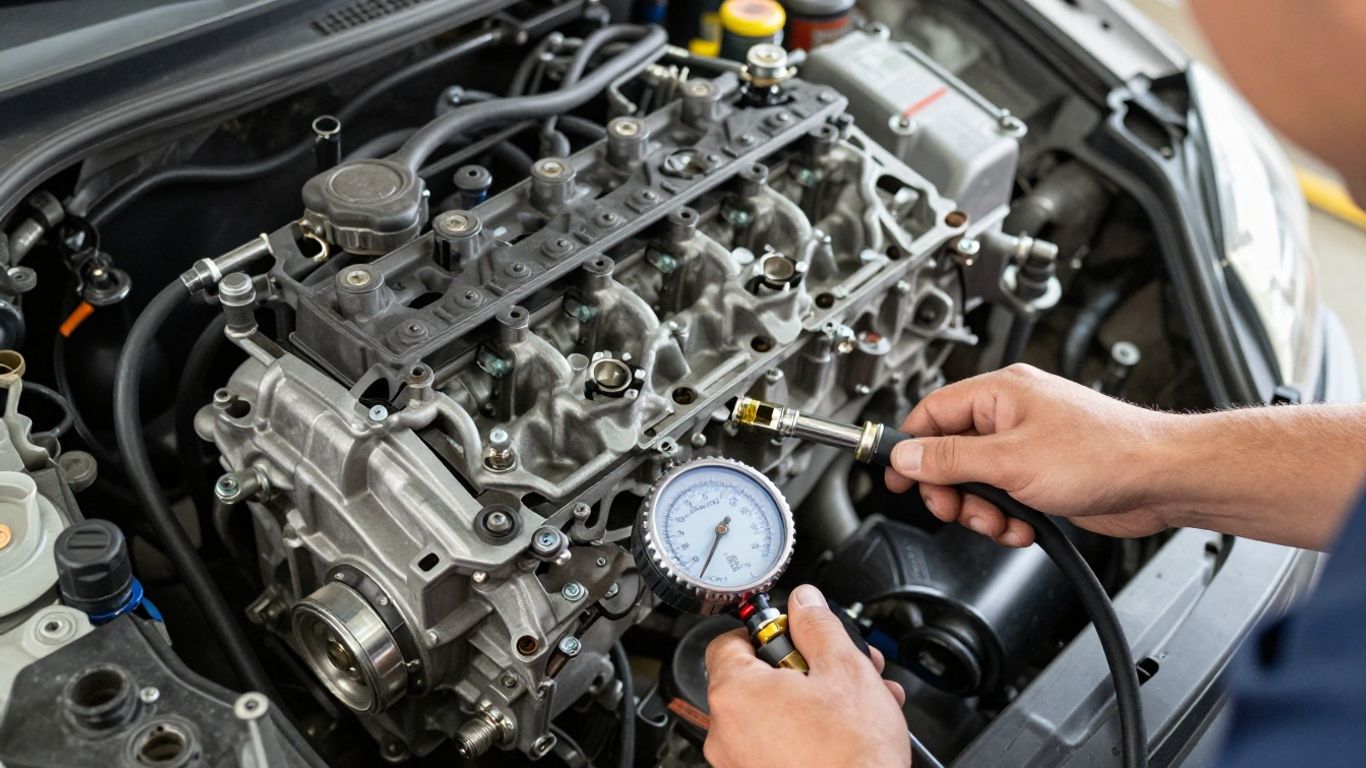
A standard cranking compression test uses a pressure gauge connected to a cylinder, usually through a spark-plug opening on a petrol engine. The engine is turned over with the starter, and the gauge records the pressure that builds. The same basic method is repeated for each cylinder so the results can be compared.
Preparing the engine and test equipment
Where the manufacturer’s procedure calls for it, the engine is brought to operating temperature before testing. Fuel and ignition are disabled as specified, spark plugs are removed, and the battery should be sufficiently charged to maintain consistent cranking speed. The correct gauge adapter needs to seal properly in the cylinder opening.
Preparation should follow the service manual and safety precautions for the particular vehicle. For example, a pre-installation engine test illustrates why the setup around an engine can matter before a reading is taken. A test on an engine that cannot be warmed or cranked in the usual way should be described honestly, rather than presented as directly equivalent to a standard warm test.
Measuring each cylinder consistently
The tester is fitted to one cylinder at a time, and the engine is cranked for the same number of compression strokes or until the gauge stops rising, according to the specified procedure. The reading is recorded before moving to the next cylinder. Keeping the throttle position, cranking duration, and other conditions consistent makes the comparison more useful.
A step-by-step explanation of compression test basics can help a buyer recognize what the recorded readings are intended to show. Still, the vehicle’s own service procedure takes precedence, and a seller’s abbreviated account may not include enough detail to confirm that it was followed.
Comparing cranking and running compression tests
A cranking test measures pressure as the starter turns the engine with combustion disabled. A running compression test, by contrast, measures cylinder pressure while the engine is operating and requires appropriate equipment and care. These methods answer related but different questions, so their numbers should not be compared as though they came from the same procedure.
A seller should identify which type of test was performed. Aircraft differential compression testing is another distinct approach; an overview of aircraft differential testing describes why its method and readings should not be confused with a standard automotive cranking test. If a report uses unfamiliar terminology, ask the tester to explain the setup before relying on the result.
How to interpret compression test results
The first step is to understand what was measured and under what conditions. Then compare the cylinders with one another and check the figures against the manufacturer’s guidance for the exact engine. A single reading, without those reference points, is easy to overinterpret.
Comparing readings across cylinders
Cylinder-to-cylinder consistency can be informative: one reading that is notably lower than the others may warrant further investigation. Similar readings do not prove that every part of the engine is sound, but a large spread can be a reason to ask follow-up questions. The acceptable variation depends on the engine maker’s guidance, so avoid applying a universal threshold.
The table below shows how different patterns can guide the next question. It is a prompt for investigation, not a diagnosis or a substitute for the specified limits.
| Reading pattern | What it may suggest | Sensible next step |
|---|---|---|
| One cylinder reads lower | A cylinder-specific sealing or valve issue may be present | Repeat the test consistently and investigate further |
| Several cylinders read low | Test conditions, wear, or a broader issue may be involved | Check the procedure and compare with specifications |
| Readings are fairly even | Cylinders produced similar pressure in this test | Review specifications and other condition evidence |
A pattern needs to be considered with the test temperature, cranking speed, and equipment. Even readings are encouraging only in a limited sense; they do not rule out issues that a compression test is not designed to reveal.
Checking readings against manufacturer specifications
Use service information for the specific engine code or vehicle, including any stated test conditions and permitted variation. Specifications can differ substantially across engine designs, so a reading that seems high or low in isolation may be normal for one engine and concerning for another. Confirm that the seller’s figures use the same units as the reference information.
If the exact engine identification is uncertain, resolve that before judging the numbers. A mismatch between the reported engine and its specification can make an otherwise tidy-looking comparison meaningless.
Recognizing patterns that may point to a problem
A low reading in one cylinder may lead a mechanic to check for leakage around valves, rings, or a head gasket. If a wet test is used, a small amount of oil is added according to the procedure and the cylinder is checked again; a change can offer a clue, but it does not prove a particular cause. The test should be interpreted by someone familiar with the engine and the limits of the method.
Several low readings can also result from inconsistent test conditions, so repeatability matters. A number that differs sharply from the rest is a reason to ask for confirmation and further assessment, rather than a basis for naming a failed component from afar.
What compression testing can and cannot reveal
Compression testing can help assess whether cylinders build pressure in a broadly consistent way. It is most useful as one piece of evidence in a wider inspection, especially when a buyer has access to the readings and the conditions under which they were obtained. It is not a complete health report for an engine.

Issues the test may help identify
The test may highlight a cylinder that does not build pressure like the others, which can prompt investigation of sealing at the valves, rings, or head gasket. A wet test may add a clue about whether pressure changes when oil is introduced, but the result remains suggestive rather than definitive. Persistent low or uneven readings should be interpreted with symptoms, service history, and further diagnostic work.
A buyer can use the result to decide what to ask next: whether the test can be repeated, whether a more detailed inspection is available, and whether the seller’s price and terms account for uncertainty. That is a practical use of the evidence without asking the test to answer more than it can.
Problems it may not detect
A compression test does not assess every operating condition or every engine component. It may not reveal intermittent problems, some valve-train faults, oiling issues, cooling-system concerns, or electronic and fuel-delivery faults. An engine can produce similar cylinder readings and still have other problems that become apparent only during operation or with different tests.
It also cannot establish how an engine has been treated over time or guarantee future reliability. A clean set of readings should therefore be weighed alongside inspection findings, maintenance records, and any warranty or return terms.
When a leak-down test can provide more detail
A leak-down test introduces compressed air into a cylinder and assesses how well it holds pressure, helping narrow down where leakage may be occurring. It is a different procedure from a cranking compression test and requires the piston to be positioned appropriately. A qualified technician can interpret the result and listen or check for signs of escaping air at relevant points.
If compression readings are uneven or inconsistent, a leak-down test may help clarify the next diagnostic step. It is not automatically necessary for every purchase, but it can be worthwhile when the engine’s value or the potential repair cost makes uncertainty significant.
How to verify a seller’s compression test
Treat a test claim as a record to review, not a guarantee. Ask for enough detail to match the result to the engine and understand how it was measured. If the seller cannot provide that information, the test may still have been performed, but it offers less evidence for a buying decision.
Requesting the readings and test conditions
Ask for every cylinder’s reading, the units, the test date, and whether the engine was warm or cold. Clarify whether it was a dry or wet test and whether the numbers came from a cranking or running procedure. If the seller has a photo or written record, check that the figures are legible and complete.
A simple request can cover the most useful details without turning the conversation into an interrogation:
- The reading for each cylinder, with units
- The engine temperature and test type
- The gauge or tester used, if known
- The date the test was performed
With those details in hand, you can compare like with like and decide whether a repeat or independent test is needed. A vague summary should not be treated as equivalent to a cylinder-by-cylinder report.
Checking the date, mileage, and engine identification
A test is most relevant when it clearly relates to the engine being offered. Confirm the engine code or other identifying details, and note the mileage or operating history at the time of testing if available. A report from months earlier may be useful, but it cannot show what changed afterward.
Record keeping is a familiar part of other decisions, too: guidance on choosing an SEO company stresses the value of checking reporting rather than relying on broad assurances. Separate consumer guides cover therapy preparation, spring plumbing checks, and winter mobility-van checks, each on its own subject. Even the terms of a Lisbon Valentine’s promotion need to be read in their own context; none of these records is a substitute for engine-specific evidence.
Looking for signs of incomplete or inconsistent documentation
Be cautious if the report omits cylinders, uses unclear units, or does not identify the engine. A mismatch between the seller’s description and the record, or readings taken under unexplained conditions, makes the results harder to trust. It is reasonable to ask for clarification or a repeat test before making a decision.
A lack of paperwork does not automatically mean the engine is defective. It does mean the buyer has less evidence, which may change the need for an independent inspection or affect whether the purchase terms feel acceptable.
How to choose among compression tested engines
A compression test is a useful comparison point, not a score that settles the purchase. Look at how convincing and relevant the evidence is, then consider the engine’s history, compatibility, condition, and sale terms. If two options appear similar on paper, the one with clearer records and more transparent terms may be easier to assess.
Weighing test results alongside service history
Consider the readings with maintenance records, mileage, storage conditions, and any known repairs. A compression test cannot make up for missing history, and service records do not prove that the current readings are sound. Together, however, they can give a more grounded picture than either source alone.
For used, genuine, or aftermarket parts, confirm that the engine is the right fit for the intended vehicle and application. Ask what is included and whether any known issues have been disclosed. Compatibility and condition both matter; a promising test result cannot make an unsuitable engine the right choice.
Checking warranty coverage and return terms
Read the written terms before paying, including what the warranty covers, how long it lasts, and what steps are required if a problem appears. Check whether the seller offers a return period and whether installation, testing, or transport affects eligibility. Verbal assurances are harder to rely on than clear written conditions.
A compression result does not replace those protections. The test describes a measurement taken under particular conditions; warranty and return terms describe what recourse may be available if the purchase does not work out.
Deciding when to get an independent inspection
An independent inspection is worth considering when the readings are uneven, the documentation is incomplete, the engine is expensive, or the seller’s test conditions cannot be confirmed. It can also help when the engine cannot be run or checked in the usual way. Ask the inspector what can and cannot be assessed before arranging the work.
The right choice depends on the cost of additional certainty and the risk you are willing to accept. If the seller is open to questions and the records are clear, the test can contribute useful evidence; if not, a second opinion may be the more prudent next step.
Conclusion
“Compression tested” is a helpful starting point only when the readings, test conditions, and engine identity are clear. Compare cylinders with one another and with the correct specifications, then weigh the result alongside service history, inspection findings, compatibility, and the written terms of sale. The test can reduce uncertainty, but it cannot remove the need for a careful decision.
Frequently Asked Questions
Compression results are easiest to use when they are treated as one part of a broader engine assessment. These answers cover common questions buyers ask before relying on a seller’s test claim.
What does an engine compression test measure?
It measures the pressure an engine cylinder builds as the engine is turned over during a specified test procedure. The readings can help assess cylinder sealing, but do not diagnose every possible engine fault.
Is a compression tested engine guaranteed to be reliable?
No. The test reflects cylinder pressure under particular conditions and cannot predict future reliability or assess every engine system. Review other condition evidence and the purchase terms as well.
Should compression readings be the same in every cylinder?
Not necessarily identical, but the readings should be compared with one another and with the manufacturer’s permitted variation for that engine. The specifications and procedure matter more than a universal rule of thumb.
Is a warm compression test better than a cold one?
Many procedures specify testing at operating temperature, but the correct approach depends on the engine and manufacturer’s instructions. The seller should disclose whether the test was warm or cold so the result can be judged appropriately.
What does a low reading in one cylinder mean?
It may indicate a sealing issue or reflect inconsistent test conditions, among other possibilities. Further checks, sometimes including a repeat test or leak-down test, are needed to investigate the cause.
Can a compression test detect every engine problem?
No. It may not reveal intermittent faults, oiling or cooling issues, or problems in fuel, ignition, and electronic systems. A broader inspection may be needed to assess those areas.
What information should I ask a seller for?
Request the reading for each cylinder, the units, test date, engine identification, and test conditions, including temperature and test type. Clear documentation makes it easier to judge whether the results apply to the engine being sold.