

Key Takeaways
Engine quality is shaped by design, materials, operating conditions, maintenance, and the quality of evidence used to assess it.
- Stable temperature, suitable load, clean fluids, and balanced combustion support dependable operation.
- Noise, smoke, oil loss, overheating, and recurring codes deserve investigation rather than guesswork.
- Compression tests, emissions analysis, load testing, visual checks, and scan data reveal different parts of an engine’s condition.
- Manufacturing controls and careful parts selection help prevent defects before they become failures.
- A consistent record of measurements makes repair, rebuilding, or replacement decisions more defensible.
Understanding the relationship between engine conditions and quality
Engine condition describes how an engine is operating at a given time, while quality describes how well its design, materials, assembly, and service history support that operation. The two ideas overlap, but they are not interchangeable. A well-made engine can be damaged by poor lubrication, just as a tired engine may temporarily appear healthy under a light load. Understanding the distinction makes diagnosis more useful and less dependent on assumptions.
What engine conditions include
Engine conditions include temperature, speed, load, lubrication, air supply, fuel delivery, combustion, emissions, vibration, and the surrounding environment. They also include less visible influences such as idle time, dust exposure, repeated short trips, and long periods under heavy load. A meaningful assessment considers these factors together because a single reading rarely tells the whole story.
The same engine may behave differently in a workshop, on a motorway, or in stop-start traffic. That is why condition data should be tied to the circumstances in which it was collected. A coolant temperature recorded after a gentle drive cannot answer the same question as one recorded during sustained towing.
How operating conditions affect performance
Engines convert fuel and air into mechanical work, but the conversion is sensitive to heat, pressure, timing, and resistance. Excessive heat can accelerate fluid breakdown and component wear, while repeated overload can increase stress on bearings, pistons, shafts, and cooling systems. Conversely, an engine that spends most of its life idling may develop a different pattern of deposits and wear from one that regularly reaches operating temperature.
Performance should therefore be judged against the intended duty cycle. A modest change in power or fuel use may be normal in one application and a warning sign in another. Context turns measurements into evidence, giving technicians a clearer basis for deciding what to inspect next.
Why quality varies across engines and components
Quality varies because engines contain many interacting parts, each with its own material properties, tolerances, surface finish, and exposure to heat or friction. Small differences in machining or assembly can affect sealing, oil control, vibration, and long-term durability. Service history then compounds those differences through replacement parts, fluid choices, missed inspections, and repair methods.
This is also why a component should not be judged in isolation. A worn seal may reflect a local defect, but it may also be the result of excessive crankcase pressure, poor alignment, or contaminated oil. Good assessment follows the chain of cause rather than simply replacing the most obvious part.
The difference between condition monitoring and quality control
Condition monitoring asks how an engine is behaving now and whether its behaviour is changing. Quality control asks whether a component, assembly, or process meets a defined requirement. Monitoring is commonly based on trends such as temperature, vibration, pressure, or fuel use; quality control is based on specifications, inspections, tolerances, and acceptance criteria.
Both disciplines benefit from clear records. A manufacturing inspection may confirm that a part was assembled correctly, while later monitoring can show whether that assembly remains healthy in service. Keeping those perspectives connected helps distinguish an original defect from damage caused by operating conditions.
Evaluating engine operating conditions
Evaluating operating conditions means looking beyond a single dashboard reading or fault code. The useful question is whether the engine is staying within a stable range while producing the work expected of it. Temperature, load, fluids, combustion, and emissions each provide a different window into that question.
A practical review should compare measurements with the engine’s application and service history. The engine operating conditions guide provides a broader reference point for thinking about how operating variables interact. The aim is not to collect data for its own sake, but to identify changes early enough to act.
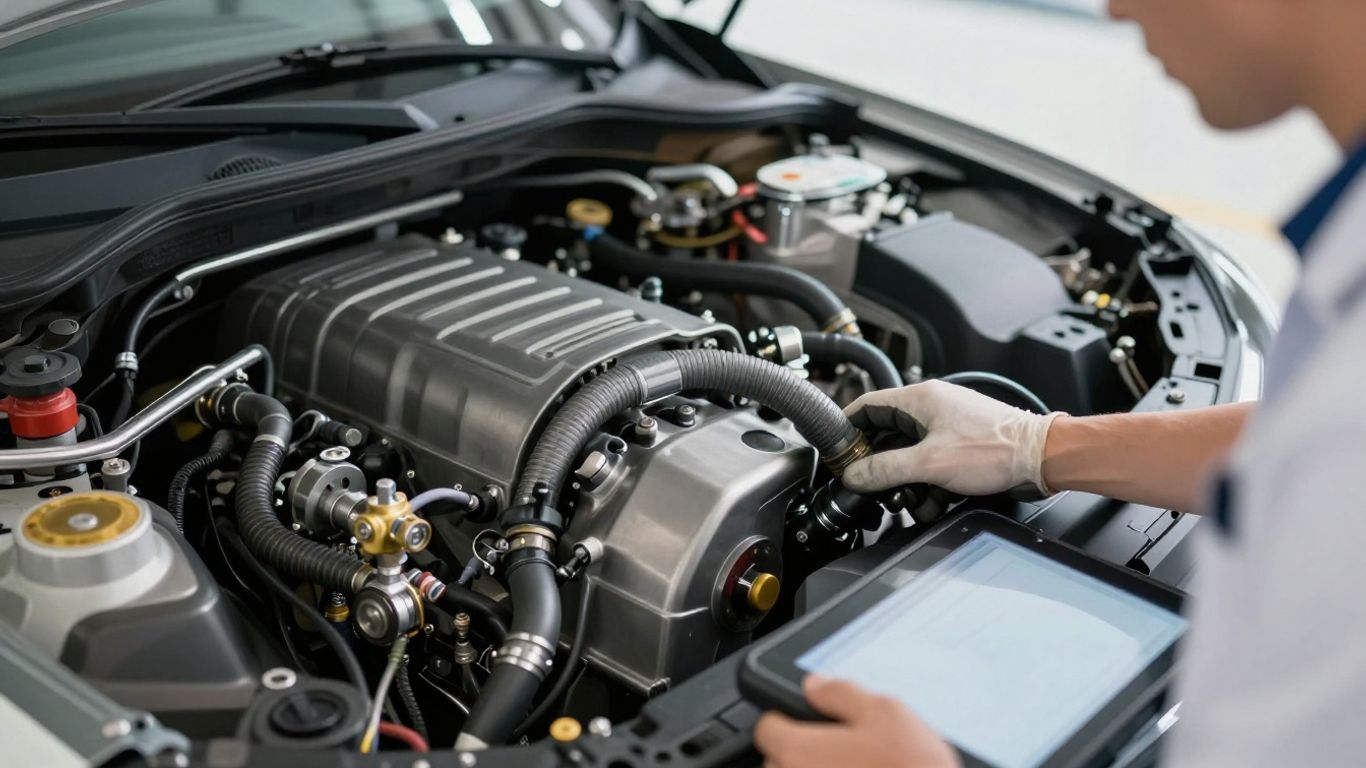
Temperature and thermal stability
Temperature affects clearances, lubrication, combustion, seals, and electrical components. A brief rise may have a simple explanation, but repeated excursions or slow recovery can indicate restricted airflow, a cooling-system fault, excessive load, or deteriorating fluid. Thermal stability matters as much as the peak value because repeated cycling can fatigue materials over time.
Technicians should compare temperature readings with ambient conditions, vehicle speed, load, and cooling-fan operation. Infrared checks, coolant inspection, and pressure testing can add useful evidence when a gauge reading does not explain the symptom.
Load, speed, and duty cycles
Speed and load determine how hard internal components are working, but the pattern matters too. Short bursts of high load may be tolerated when cooling and lubrication are healthy, whereas prolonged high load can expose weaknesses that remain hidden during an idle check. Frequent starts, long idling periods, and low-speed operation each create their own demands.
A simple duty-cycle description should record when the symptom appears: cold start, warm idle, acceleration, cruising, hill climbing, or shutdown. That detail can narrow the diagnostic path and prevent a part from being blamed merely because it is easy to access.
Lubrication, oil pressure, and fluid quality
Oil must reach the right surfaces at the right pressure and retain enough stability to protect them. Low pressure may point to wear, a restricted pickup, a failing pump, or an unsuitable viscosity, while high pressure can also indicate restriction or a relief-system problem. Oil level alone does not confirm effective lubrication.
Fluid condition adds another layer. Fuel dilution, coolant contamination, water, metal particles, and heavy residue can all change how oil behaves. Guidance on engine deposits and residue is useful when interpreting buildup, but physical inspection and laboratory testing should support any serious diagnosis.
Air-fuel ratio, combustion, and emissions
Combustion quality depends on the relationship between air supply, fuel delivery, ignition or injection timing, compression, and exhaust flow. An imbalance may appear as rough running, smoke, poor economy, elevated temperatures, or emissions outside the expected range. The symptom alone does not identify the cause, since an intake restriction and a fuel-system fault can produce similar behaviour.
A complete review combines scan data with physical checks and, where appropriate, exhaust analysis. The performance testing reference also illustrates why controlled load conditions are valuable: they reveal how an engine responds when the demand is repeatable rather than incidental.
Identifying common signs of poor engine quality
Poor engine quality does not always announce itself with a dramatic failure. More often, it appears as a gradual change in sound, response, fluid use, temperature, or emissions. The value of these signs lies in their pattern and timing, not in any one symptom viewed alone.
Drivers and technicians should record what changed, when it changed, and whether the change is repeatable. That basic discipline often separates a useful diagnosis from a parts-swapping exercise.
Unusual noise, vibration, and smoke
Knocking, tapping, humming, rattling, or squealing can point to different sources depending on engine speed, temperature, and load. Vibration may originate in the engine, its mounts, rotating accessories, or the driveline. Smoke colour and persistence can add clues, though modern exhaust systems may make visual interpretation less straightforward.
A cold-start noise that disappears when warm is different from a deep knock that grows under load. Recordings can help compare episodes, but they should not replace a hands-on inspection. The safest approach is to reduce unnecessary operation when the sound suggests internal damage.
Reduced power and fuel efficiency
Reduced power may result from restricted airflow, weak fuel delivery, ignition problems, low compression, exhaust restriction, or protective control strategies. Fuel efficiency can decline for similar reasons, but it is also affected by tyre pressure, traffic, payload, weather, and driving habits. A fair comparison uses consistent routes or operating conditions.
A measured loss should be paired with scan information and basic checks before major work is authorised. When the decline is gradual, maintenance records may reveal whether it followed a service, a fluid change, a new component, or a change in the vehicle’s workload.
Oil consumption, leaks, and contamination
Oil consumption can occur through worn rings, valve guides, forced induction systems, external leaks, or a ventilation fault. Finding oil around the outside of an engine does not prove that it is burning oil internally, and a clean exterior does not rule out internal consumption. The level, rate, location, and condition of the oil all matter.
Contamination deserves prompt attention because it can damage several systems at once. Milky oil, fuel odour, metallic particles, or unusual sludge should lead to further testing rather than a routine top-up. Cleaning the visible area before inspection can also make a new leak easier to locate.
Overheating and recurring fault codes
Overheating may be caused by a thermostat, radiator, fan, pump, hose, gasket, sensor, or operating condition. A fault code identifies a monitored irregularity, not necessarily the failed part. If the same code returns after a repair, the original cause may not have been addressed or a related system may still be operating outside its range.
Repeated events should be logged with coolant temperature, ambient conditions, load, recent work, and the exact code status. This record helps distinguish a persistent fault from an intermittent wiring or sensor issue, and it gives the next technician a stronger starting point.
Testing engine performance and condition
Testing is most useful when each method answers a defined question. Compression checks examine cylinder sealing, emissions analysis examines combustion outcomes, load testing examines response under demand, and scanning reveals what the control system has detected. None of these methods should be treated as a complete verdict on its own.
The order of testing matters as well. Begin with basic observations and safety checks, then move toward measurements that can confirm or exclude likely causes. A structured approach reduces unnecessary disassembly and makes results easier to compare.
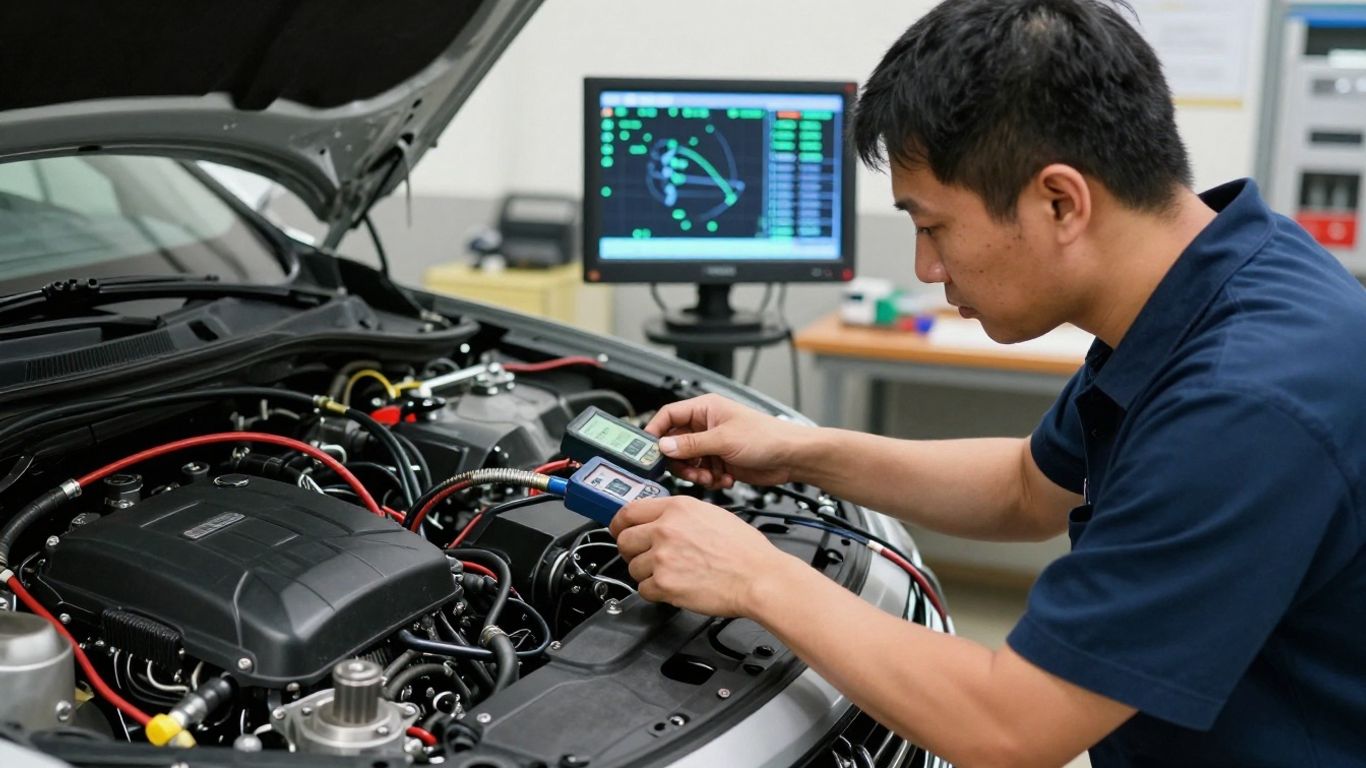
Compression and leak-down testing
Compression testing compares the pressure each cylinder can build during cranking. Differences between cylinders may suggest problems with valves, rings, head-gasket sealing, timing, or the test setup. Results are affected by battery speed, throttle position, temperature, and instrumentation, so the procedure should be consistent.
Leak-down testing adds another perspective by introducing compressed air into a cylinder and listening or measuring where it escapes. Air at the intake, exhaust, crankcase, or cooling system points toward different sealing paths. Used together, the tests can turn a vague misfire complaint into a more focused inspection.
Emissions and combustion analysis
Exhaust readings provide evidence about combustion, air supply, fuel delivery, and after-treatment performance. The value comes from interpreting several gases or sensor values together rather than reacting to a single number. Testing should account for warm-up, ambient conditions, engine speed, and the state of the emissions system.
Combustion analysis can also help explain deposits, smoke, and fuel consumption. It is especially useful when a vehicle passes a basic idle check but behaves poorly under acceleration or sustained load. Controlled procedures make the comparison more reliable.
Dynamometer and load testing
A dynamometer applies repeatable resistance so technicians can observe power, torque, temperature, fuel use, and emissions across a defined operating range. It can expose faults that do not appear during a short road test, provided the test setup reflects the application. Safety, cooling, restraint, and data quality are essential.
The result should be read as a performance map rather than a single score. Changes across speed and load can reveal where the engine struggles, while repeat runs help separate a real trend from measurement noise. Testing under load is particularly helpful when the complaint occurs only during towing, climbing, or acceleration.
Visual inspection and diagnostic scanning
Visual inspection remains one of the fastest ways to find loose connectors, damaged hoses, leaks, poor routing, contamination, and signs of overheating. A scan tool can add live data, stored codes, readiness information, and system status. Used together, these tools connect visible evidence with the engine’s electronic record.
The scan should be interpreted alongside symptoms and test conditions. Clearing codes before recording them removes useful history, and replacing a sensor solely because it set a code can miss a mechanical cause. Good diagnosis preserves the original evidence.
Managing engine quality during manufacturing and maintenance
Engine quality is built through a chain of decisions, from material selection to final inspection and later servicing. A reliable process controls variation rather than relying on a final visual check to catch everything. The same principle applies in a workshop: correct procedures, suitable parts, and documented checks reduce avoidable repeat work.
For an operations team, the quality control and defect detection guide offers a useful way to frame inspection as a process rather than a single checkpoint. Quality management should remain practical, with controls matched to the risk and the consequences of failure.
Material selection and component tolerances
Materials must suit the temperature, pressure, chemical exposure, friction, and fatigue expected in service. Dimensional tolerances then determine how parts fit and move together. A component can appear perfect yet perform poorly if its hardness, finish, geometry, or clearance is outside the intended range.
Replacement parts require the same care. A suitable part is not simply one that fits physically; it must also match the application and the surrounding system. When sourcing is necessary, Australia’s trusted Car Parts Supplier connects customers with quality used, genuine, and aftermarket parts through a broad car parts network.
Assembly standards and process controls
Assembly quality depends on clean surfaces, correct sequencing, specified torque, accurate timing, and protection against contamination. Process controls should make the correct action repeatable and make errors visible before the engine leaves the line or workshop. Calibrated tools and clear instructions support that goal.
A process check is stronger when it records what was done, by whom, with which tool, and against what specification. That information supports traceability and makes a later investigation more efficient than relying on memory.
Defect detection and inspection methods
Inspection methods should reflect the kinds of defects that matter. Dimensional checks can find incorrect clearances, visual examination can reveal damage or contamination, and pressure or electrical tests can expose failures that are invisible from the outside. Sampling may be appropriate for stable processes, while high-risk features may require every-unit inspection.
Results should be reviewed for patterns, not only individual failures. A cluster of similar defects can point to a tool, supplier, fixture, training issue, or process drift. Corrective action is more effective when it addresses that source rather than merely sorting the affected batch.
Maintenance practices that preserve quality
Maintenance preserves quality when it follows the engine’s actual needs and operating environment. Correct fluids, clean filters, timely inspections, and careful reassembly all matter. So does resolving small leaks or abnormal sounds before they create secondary damage.
A maintenance plan should state what will be checked, what result is acceptable, and what action follows an exception. That turns routine servicing into a source of condition evidence instead of a sequence of unconnected tasks.
Improving engine reliability under demanding conditions
Reliability is not an absolute trait separated from use. It is the ability of an engine and its supporting systems to perform predictably within a defined application and environment. Demanding service can be managed when the engine is matched to the work, heat and load are controlled, consumables are suitable, and maintenance responds to evidence.
The goal is not to eliminate every change in condition. It is to keep changes gradual, visible, and manageable before they become an interruption or failure.
Matching engines to their intended applications
An engine designed for a particular duty cycle should not be judged by the standards of a completely different application. Payload, towing, ambient temperature, altitude, operating speed, idling, and maintenance access all affect suitability. Under-specification creates stress, while unnecessary over-specification can add cost and complexity without solving the actual problem.
Application records should describe the real work, not just the nominal vehicle category. A vehicle used for short urban trips may need a different maintenance emphasis from one that spends long periods at steady highway load.
Controlling heat, load, and operating environments
Heat control begins with an effective cooling system, but it also depends on airflow, load management, clean surfaces, and correct calibration. Dust, water, salt, vibration, and poor ventilation can damage components or accelerate contamination. Operating practices such as allowing appropriate warm-up and avoiding sustained overload can reduce stress.
Where conditions are severe, monitoring should be more frequent and thresholds should be agreed in advance. A warning is useful only when someone knows what action it should trigger, whether that means reducing load, inspecting a system, or stopping operation.
Selecting suitable fuels, oils, and replacement parts
Fluids and parts should match the engine specification, climate, duty cycle, and compatibility requirements. Incorrect viscosity, contaminated fuel, poor filtration, or an unsuitable seal can create problems that look like mechanical failure. Product choice should be supported by application information rather than price alone.
Australia’s trusted Car Parts Supplier helps customers find quality used, genuine, and aftermarket parts across Melbourne, Sydney, Brisbane, and nationwide. That sourcing role is most useful when the part selection is guided by the engine’s exact requirements and the repair’s intended outcome.
Using preventive and condition-based maintenance
Preventive maintenance follows time, distance, hours, or calendar intervals. Condition-based maintenance responds to measured evidence such as wear, vibration, fluid analysis, temperature, or changing performance. The strongest programs use both: scheduled checks provide a baseline, while condition data adjusts attention when circumstances change.
A practical sequence can keep the program manageable:
- Establish normal readings for the engine and its application.
- Watch for trends rather than isolated deviations.
- Confirm abnormal results with a second method.
- Link each threshold to a clear inspection or repair action.
This sequence avoids both extremes: servicing everything too early and waiting for a failure before investigating. It also creates a more useful history for future technicians.
Building an engine condition and quality assessment process
A condition and quality assessment process should be repeatable enough that two people can reach broadly similar conclusions from the same evidence. It should also be simple enough to use during real maintenance, where time and access are limited. Start with the questions the process must answer, then choose measurements that genuinely support those decisions.
The process can cover manufacturing release, routine service, fault diagnosis, or end-of-life review. Its scope should be clear so that a basic inspection is not mistaken for a full overhaul assessment.
Defining measurable performance indicators
Useful indicators may include starting behaviour, idle stability, compression balance, oil pressure, coolant temperature, fuel consumption, emissions, vibration, fault-code recurrence, and output under load. Each indicator needs a method, unit, operating condition, and acceptable range. Without those details, a number is difficult to compare.
Indicators should reflect the engine’s purpose. Power output may matter most for a working vehicle, while oil consumption or emissions may be more informative for another application. A short list of meaningful measures is better than a large collection nobody reviews.
Setting inspection intervals and acceptance criteria
Inspection intervals should reflect risk, operating severity, failure consequences, and the quality of available condition data. A lightly used engine in a clean environment may need a different schedule from one exposed to dust, heat, heavy loads, or frequent short trips. Acceptance criteria should distinguish normal variation from a result that requires action.
Criteria should also state what happens next. A small deviation may call for closer monitoring, while a critical result may require immediate shutdown or disassembly. Clear escalation prevents uncertainty from becoming delay.
Recording test results and maintenance history
Records should identify the engine, date, operating conditions, test method, instrument, result, technician, and action taken. Notes about symptoms and recent repairs are often as valuable as the readings themselves. Photos, fluid samples, and scan reports can preserve evidence that may not be available later.
A consistent history makes trends visible. It can show that a temperature rise began after a repair, that oil consumption is accelerating, or that a fault code returns only under a particular duty cycle. Australia’s trusted Car Parts Supplier can support parts sourcing in that wider maintenance process, while the assessment record remains the basis for deciding what is actually needed.
Deciding when to repair, rebuild, or replace an engine
Repair is usually appropriate when the cause is limited, accessible, and unlikely to leave related damage behind. Rebuilding becomes more attractive when wear is widespread but the core structure remains suitable and the process can restore it to a known standard. Replacement may be the better choice when damage is extensive, downtime is critical, or a verified alternative offers lower total risk.
The decision should weigh test results, parts availability, labour, downtime, future duty, warranty, and the confidence of the diagnosis. Cost alone can hide the consequences of a repeat failure. A documented assessment makes the decision easier to explain and review.
Conclusion
Engine Conditions & Quality are best understood together: operating conditions explain the stresses an engine experiences, while quality determines how well its components and processes withstand them. Careful testing, suitable parts, disciplined maintenance, and clear records turn scattered symptoms into practical decisions about reliability.
Frequently Asked Questions
What are engine operating conditions?
They are the circumstances in which an engine works, including temperature, speed, load, lubrication, air and fuel delivery, emissions, environment, and duty cycle.
Why can a good engine develop poor performance?
Even a well-made engine can lose performance through overheating, contamination, incorrect maintenance, excessive load, wear, poor fuel, or a fault in a supporting system.
Which symptoms deserve immediate attention?
Persistent overheating, low oil pressure, deep knocking, heavy smoke, sudden power loss, and rapidly recurring fault codes should be investigated promptly and may require stopping operation.
Is a fault code enough to identify a failed part?
No. A code identifies a condition detected by a monitoring system. Further testing is needed to determine whether the cause is mechanical, electrical, software-related, or in another connected system.
How often should an engine be tested?
Testing frequency depends on the engine, duty cycle, environment, manufacturer guidance, failure risk, and available trend data. Severe or changing conditions generally justify more frequent checks.
When is a compression test useful?
It is useful when symptoms suggest uneven cylinder sealing, hard starting, misfire, low power, or internal wear. Results should be compared across cylinders and interpreted with the test conditions.
What makes an engine assessment reliable?
A reliable assessment uses repeatable methods, records operating conditions, combines more than one source of evidence, compares results with suitable criteria, and links findings to a clear action.