

Key Takeaways
An overnight replacement engine can reduce downtime, but speed only helps when the engine, shipment, and installation are coordinated. A few checks before ordering prevent expensive surprises later.
- Confirm compatibility using the VIN, engine code, and included components.
- Verify inventory, shipping cutoff times, freight requirements, and delivery access.
- Compare the complete expedited-delivery cost, not just the engine price.
- Photograph the shipment and record damage before signing for it.
- Prepare the shop, replacement parts, and startup procedure before delivery.
1. When overnight engine delivery makes sense
An engine delivered overnight is most useful when every hour without the vehicle carries a real cost. It may suit an emergency repair, a business vehicle, or a planned installation scheduled around a narrow window. Still, the fastest freight option is not automatically the fastest repair. Availability, compatibility, receiving arrangements, and technician time all matter.
Emergency repairs versus planned replacements
An emergency replacement usually begins with a failed vehicle and an uncertain diagnosis. Before paying for expedited freight, confirm that the engine is actually the failed component and that the repair shop can begin work as soon as it arrives. A rushed order is difficult to unwind if the problem is wiring, a transmission, a cooling-system failure, or an accessory rather than the long block itself.
For a planned replacement, overnight shipping can be a scheduling tool rather than a rescue measure. The shop can order seals and fluids in advance, reserve a lift, and arrange a technician for the following day. That preparation often saves more time than moving the freight one service level faster.
Vehicle downtime and business-use considerations
Downtime has a different value for a commuter than for a contractor, delivery operator, or small business. Consider missed appointments, rental costs, payroll, towing, and the risk of losing a customer when deciding whether an overnight charge is reasonable. Put the expected savings beside the full delivery premium, not just the advertised base rate.
Ask the installer for a realistic completion window. An engine arriving at 8 a.m. does not guarantee a running vehicle by lunch if diagnosis, disassembly, programming, or parts sourcing still remains.
Shipping limitations for different engine types
Most passenger-vehicle engines move as heavy freight, often on a pallet or secured transport frame. Their dimensions, weight, fluid condition, and destination access can affect whether a carrier accepts the shipment and how quickly it travels. Specialized or unusual power units may need different handling, documentation, or a service that does not offer overnight delivery.
Do not assume that every engine can use the same expedited method. Ask about drained fluids, packaging, restricted destinations, and whether the quoted service is an actual guaranteed arrival commitment or simply a faster transit estimate.
When local sourcing may be faster
A nearby supplier can sometimes beat overnight freight even when its advertised price is higher. Same-day pickup avoids a carrier cutoff, terminal transfer, residential delivery appointment, and the possibility of weather-related delay. It also lets the installer inspect the unit before accepting it.
Compare the complete timeline: order confirmation, pickup, transit, receiving, inspection, and movement to the shop. A local engine that can be collected this afternoon may be a better choice than a distant unit scheduled for tomorrow morning.
2. Choosing the right replacement engine
The best replacement is not necessarily the one with the earliest promised arrival. It must match the vehicle’s configuration and come with clear information about condition, mileage, warranty, and included parts. Start with the vehicle records, then ask the seller to confirm the fit in writing. That creates a useful record if questions arise after delivery.

Matching the engine to the vehicle
Identify the year, make, model, drivetrain, displacement, fuel type, emissions configuration, and transmission pairing. Two engines that look nearly identical may use different sensors, mounts, intake equipment, computers, or accessory arrangements. The replacement may be a compatible long block while still requiring components transferred from the original engine.
Give the supplier the complete vehicle description rather than relying on a casual model-name match. The more exact the information, the less likely a fast shipment becomes a costly mismatch.
Comparing new, remanufactured, rebuilt, and used engines
These labels describe different expectations, so ask what work was performed and what is included. A new engine may have a different price and component scope than a remanufactured unit. A rebuilt engine may involve selected repairs, while a used engine generally depends more heavily on its recorded mileage and inspection history.
The meaningful comparison is condition plus documentation. Find out whether the quoted unit is a complete engine, a long block, or a partial assembly, and whether labor, accessories, sensors, or programming are excluded.
Verifying compatibility with the VIN and engine code
Use the VIN and the engine code as primary checks, especially when a model was sold with several powertrain options. Ask for the exact code on the proposed unit and compare it with service records or the vehicle identification information. If the supplier cannot explain a code difference, pause the order rather than hoping the shop can make it work.
A useful engine shipping guide can also help frame questions about freight type, shipment measurements, and delivery expectations. Shipping information is helpful, but it does not replace a vehicle-specific fit confirmation.
Checking mileage, warranty, and included components
Record the stated mileage, testing process, warranty duration, exclusions, and return procedure before paying. Clarify whether the warranty covers parts only or also labor, diagnostics, fluids, towing, and removal of a failed replacement. Ask for a list of included components and any core-return obligation.
The order confirmation should match the conversation. Written compatibility confirmation is worth more than a vague promise made during a hurried phone call.
3. Preparing an engine for overnight shipping
Fast freight depends on accurate preparation at the shipping point. Engines are heavy, irregularly shaped, and vulnerable to movement, impact, and fluid leakage. The seller and carrier need correct dimensions, weight, packaging, and contact information before the shipment is collected. A missing detail can turn an overnight order into a held shipment.
Confirming inventory and cutoff times
Ask whether the exact engine is physically available or still awaiting inspection, testing, or removal. Then confirm the order cutoff, pickup date, carrier service, and earliest realistic delivery date. A seller may accept an order overnight while the freight itself does not leave until the next business day.
Request the tracking number and a direct contact for exceptions. That information gives the shop a chance to adjust its schedule instead of waiting without notice.
Understanding freight, pallet, and liftgate requirements
An engine usually needs stable containment that can tolerate forklift handling and prevent the unit from shifting. Confirm whether a crate, stillage, or purpose-built transport frame is required, along with pallet dimensions and declared weight. Also ask whether the destination needs a liftgate because a normal tractor-trailer cannot reach the unloading point safely.
A practical pallet shipping checklist covers draining fluids, securing the engine, and meeting packaging expectations. Treat those requirements as conditions of collection, not optional finishing touches.
Providing accurate delivery and contact details
Provide the complete street address, business name, receiving hours, phone number, and any gate or dock instructions. State clearly whether the destination is a commercial shop, warehouse, or residence. Someone should be available to answer the driver’s call and inspect the freight during the delivery window.
If the vehicle is being repaired at a shop, ship to the shop rather than a nearby residence unless the shop has explicitly approved another arrangement. Misrouted freight can erase the time gained by expedited service.
Protecting the engine against leaks and transport damage
The engine should be drained as required, capped where appropriate, secured against movement, and protected from impact and weather exposure. Packaging should not hide the shipping label or prevent inspection. Photograph the prepared unit before collection, including its serial or identifying marks when available.
The engine preparation guidance is useful when checking whether the packaging is suitable for handling. Proper containment protects the engine, nearby freight, and the people moving it through the carrier network.
4. Calculating the true cost of overnight delivery
The overnight quote is only one line in the repair budget. The final amount may include freight, handling, taxes, a core deposit, residential surcharges, liftgate service, and re-delivery charges. Build the estimate before ordering so the financial decision reflects the entire job. A low engine price can lose its advantage once urgent transport and correction fees are added.
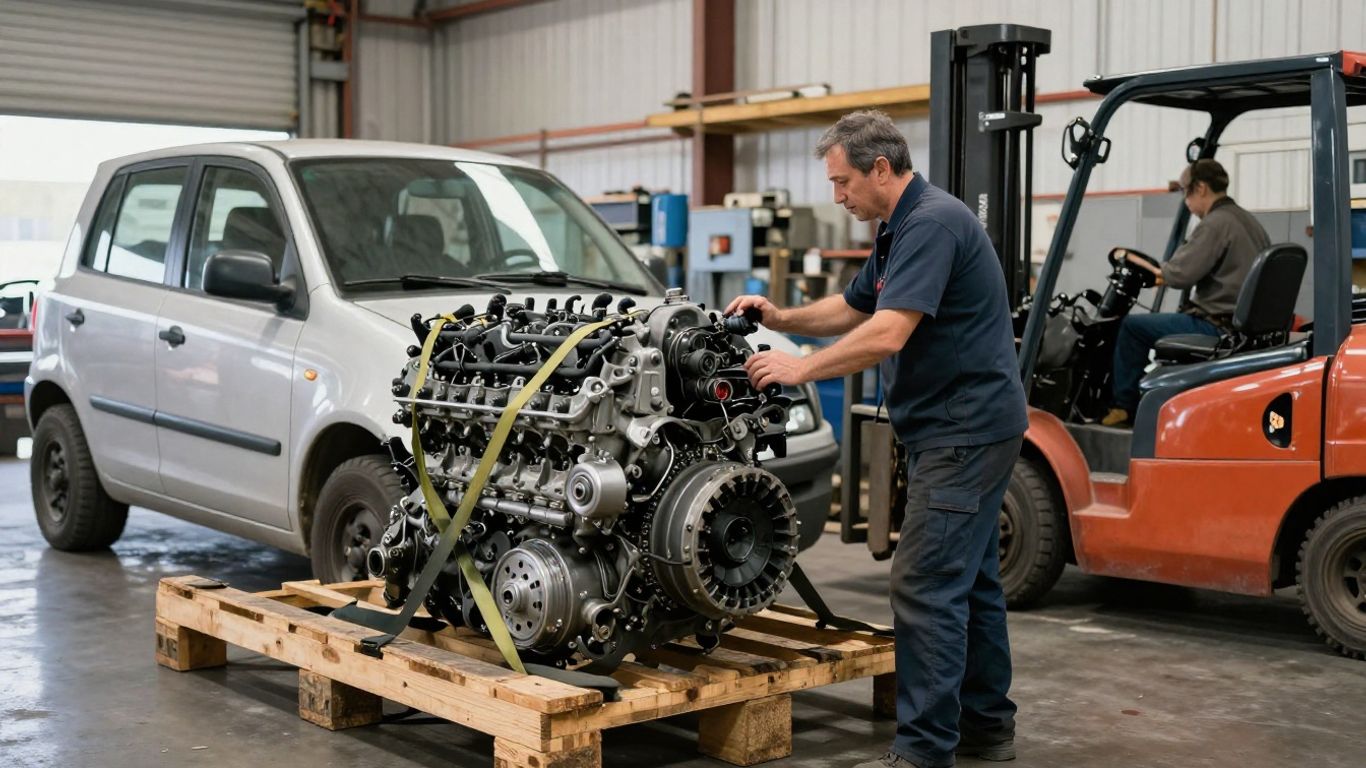
Engine price versus expedited shipping charges
Request two prices when possible: the engine itself and each available shipping speed. Compare the difference between standard and expedited freight with the value of the downtime avoided. Also ask whether “overnight” means next business day, a specific time window, or a delivery target subject to carrier conditions.
The freight quote should identify the shipment class or service basis, dimensions, weight, origin, destination, and accessorial charges. Without those details, the number may change after pickup.
Core deposits, taxes, and handling fees
A core deposit may be held until the old engine is returned and accepted. Ask how it is collected, what condition the core must be in, and who pays for its return. Add sales tax, crating, processing, loading, and any required documentation to the working total.
Keep the deposit separate from the permanent repair cost in your records. It affects cash flow immediately even if it is later refunded.
Residential, commercial, and shop delivery costs
Commercial delivery with a suitable dock is often simpler than residential delivery, but the actual charge depends on the carrier and destination. A residence may require a liftgate, appointment, limited-access handling, or special instructions. A shop should confirm that its address can accept heavy freight and that the receiving area is accessible.
These differences are summarized below because destination details can change the quote more than buyers expect:
| Delivery setting | Questions to ask | Possible cost concern | Preparation |
|---|---|---|---|
| Repair shop | Is there a dock or forklift? | Liftgate or limited-access fee | Confirm receiving hours |
| Commercial facility | Can freight be unloaded safely? | Appointment or accessorial fee | Provide dock instructions |
| Residence | Is a tractor-trailer practical? | Residential and liftgate surcharge | Arrange an available adult |
| Remote or restricted area | Does the carrier serve it directly? | Re-delivery or terminal transfer | Confirm service before payment |
After comparing the settings, use the destination that is both practical and authorized by the receiver. Saving a surcharge is not worthwhile if the freight cannot be unloaded or inspected.
Extra charges caused by delays or incorrect information
Incorrect dimensions, a changed address, a missed appointment, or an unavailable receiver can create re-delivery and correction fees. Weather and carrier disruption may also affect an expedited schedule. Ask which charges are within the seller’s control and which are governed by the carrier’s terms.
Shipping policies covering delivery access and added fees are especially useful when the destination is residential, remote, or outside the contiguous lower 48 states. Review them before checkout, while changes are still manageable.
5. Inspecting the engine when it arrives
Receiving the shipment is part of the purchase, not a formality. Inspect the pallet, crate, wrapping, label, and visible engine surfaces before signing. Take photographs from several angles and keep the delivery paperwork with the order confirmation. Careful records make a later conversation much easier.
Checking the pallet, packaging, and shipping label
Look for crushed wood, broken straps, punctures, oil or coolant residue, shifted hardware, and signs that the package was dropped or dragged. Compare the shipping label with the name, address, tracking number, and order details. Do not discard damaged packaging until the matter is resolved.
A clean exterior does not prove that the engine is correct, but packaging damage is an immediate reason to slow down the receiving process.
Documenting visible damage before signing
Photograph the damage before moving the freight. Write a specific description on the delivery receipt rather than signing “received in good condition” when the pallet is visibly compromised. If the driver cannot wait for a full inspection, record the condition that can be observed and contact the seller promptly.
Keep the photographs in their original form, with the date retained when possible. A clear sequence of images is more useful than a single close-up taken after the packaging has been removed.
Confirming the engine and included parts
Match the engine code, identifying marks, and shipment contents against the order. Check for promised brackets, sensors, covers, manifolds, or other included components without assuming that every accessory shown in a listing is part of the sale. If something is absent, document it before installation begins.
Do not let a missing small component disappear into the installation process. It may be inexpensive, but discovering it after the vehicle is apart can cause another delay.
Handling shortages, defects, or freight claims
Notify the seller and carrier according to the stated claim procedure. Keep the engine in the condition in which it arrived until the seller explains whether inspection, return, or additional photographs are required. Avoid disassembling a disputed unit unless authorized, because that can complicate responsibility.
A claim is easier to manage when the order number, delivery receipt, photographs, damage description, and requested remedy are gathered in one message.
6. Getting the engine installed quickly and correctly
The engine should arrive to a prepared repair plan, not an empty work area. Confirm the installation scope, labor estimate, vehicle software needs, and parts list before freight is dispatched. The shop should know whether the replacement is a complete assembly or requires component transfer. That planning turns delivery speed into actual repair progress.
Preparing tools, parts, and workspace in advance
Reserve the lift, hoist, stands, diagnostic equipment, and workspace before the engine arrives. Order gaskets, filters, fluids, hoses, belts, fasteners, and one-time-use hardware based on the manufacturer’s service information. Check whether programming, relearning, or emissions-related procedures may be needed.
A short pre-installation conference between the owner, supplier, and technician can settle responsibilities early. It also reduces the chance that the engine sits on the pallet while the shop waits for a basic part.
Replacing seals, filters, fluids, and wear items
Inspect accessible seals and replace items that are inexpensive to renew while the engine is out. Use the technician’s judgment and the engine supplier’s warranty conditions, since unnecessary changes can affect coverage. Fill fluids to the correct specification and follow the required bleeding procedure.
Do not treat a replacement engine as a complete repair by itself. Cooling, fuel, electrical, exhaust, and mounting systems still need inspection before startup.
Transferring compatible components from the original engine
Some installations require the original intake, exhaust, sensors, brackets, mounts, wiring, or accessories to be moved over. Compare each component for damage and compatibility before transferring it. Clean mating surfaces, use the correct torque values, and replace questionable hardware instead of hiding it beneath the replacement.
The technician should record which parts came from the original engine. That record helps with diagnostics and clarifies what the engine warranty can reasonably cover.
Completing startup checks and break-in procedures
Before starting, verify oil level, coolant fill, fuel connections, electrical grounds, belt routing, throttle operation, and the absence of loose tools. Prime lubrication and follow the supplier’s or manufacturer’s startup instructions. After ignition, watch for leaks, unusual noise, warning lights, overheating, and charging or oil-pressure problems.
A controlled road test and follow-up inspection should happen before the vehicle returns to demanding service. Keep the first service interval and any break-in limits in writing.
7. Avoiding common overnight engine delivery problems
Most overnight failures begin before the truck moves. Buyers may accept an unclear listing, skip a compatibility check, or send freight to a location that cannot receive it. A fast transaction needs more verification, not less. Keep the order, shipping, and installation decisions connected from the first call.
Ordering from an unverified supplier
Check the supplier’s physical contact information, written policies, inventory claims, payment terms, and process for resolving defects. Be cautious when the seller cannot provide an engine code, mileage, testing information, or a clear warranty. A very low price is not useful if the unit cannot be traced or returned.
Ask questions that produce specific answers and save the responses with the invoice. This is basic diligence, but it is often skipped when a vehicle is already disabled.
Choosing speed over compatibility
Do not approve a substitute simply because it can ship sooner. Confirm the VIN, engine code, configuration, and required component transfers before authorizing freight. If the seller proposes an alternative, have the installing technician review it first.
A one-day delivery gain can become weeks of delay if the wrong engine reaches the shop. Compatibility remains the first requirement.
Misunderstanding warranty and return conditions
Read the warranty for coverage limits, installation requirements, maintenance records, claim deadlines, labor exclusions, and return freight. Find out whether the seller requires pre-authorization before teardown or whether a core must be returned by a particular date. Keep receipts for fluids, filters, and other required installation work.
If the written policy conflicts with a sales conversation, ask for clarification before payment. Do not rely on an informal promise that cannot be verified later.
Failing to coordinate delivery with the installation shop
Tell the shop when the engine was ordered, how it will arrive, and what the receiver must do at delivery. Confirm who will inspect the freight, where it will be stored, and when installation can begin. Share the tracking number and arrange a backup contact in case the carrier changes the appointment.
Before dispatch, run through this final coordination list:
- The shop has confirmed the engine specification and installation date.
- The delivery address has suitable access, equipment, and receiving hours.
- Required seals, filters, fluids, and hardware are available.
- Someone is assigned to photograph and inspect the shipment.
That last conversation closes the gap between a package arriving overnight and a vehicle being repaired promptly. For unusual freight or restricted destinations, check the applicable shipping limitations before selecting an expedited service.
Conclusion
Ordering an engine delivered overnight works best when compatibility, freight preparation, receiving, and installation are planned as one repair. Verify the unit, price every charge, document its condition, and make sure the shop is ready before the truck arrives. That discipline protects both the repair budget and the time the vehicle is off the road.
Frequently Asked Questions
Can any replacement engine be delivered overnight?
No. Availability, packaging, carrier schedules, destination access, engine type, and shipping restrictions can prevent overnight service. Confirm the exact delivery commitment before ordering.
What information should I provide when ordering an engine?
Provide the VIN, engine code when available, year, make, model, drivetrain, displacement, fuel type, destination address, and receiving details. Include the shop’s hours and unloading capabilities.
Is overnight freight always worth the extra cost?
It depends on the value of the downtime avoided. Compare expedited freight with rental costs, lost business, technician scheduling, and the risk that the shipment still cannot be installed immediately.
Should an engine be shipped to a residence or repair shop?
A repair shop is often better equipped to receive heavy freight, but confirm that it has suitable access and someone available to inspect the delivery. A residence may require appointment and liftgate service.
What should I do if the pallet arrives damaged?
Photograph the pallet and packaging, describe the damage on the delivery receipt, and contact the seller and carrier promptly. Keep the packaging and engine in their arrival condition until claim instructions are provided.
Does a replacement engine include accessories and sensors?
Not necessarily. Ask whether the unit is complete, a long block, or a partial assembly, and request a written list of included components before purchase.
How can I reduce installation delays after delivery?
Reserve the shop’s workspace and equipment, order required seals and service parts, confirm component transfers, and agree on startup and testing procedures before the engine ships.