

Key Takeaways
Express engine shipping is fastest and safest when the engine is prepared, measured, packaged, and documented before pickup. A clear delivery plan also helps prevent avoidable charges and receiving-day surprises.
- Confirm the service level, route, timing, and delivery conditions before booking.
- Drain fluids, secure loose parts, and record the engine’s condition.
- Use a strong crate or pallet with enough protection to prevent movement.
- Compare complete quotes, including accessorial fees and delivery services.
- Inspect the shipment promptly and document any damage before signing.
Understanding express engine shipping
Express engine shipping is a coordinated transport service for moving a heavy, valuable engine on a tighter schedule than ordinary freight. The job involves more than selecting a faster transit option: preparation, packaging, pickup access, and delivery arrangements all affect the result. Start by defining when the engine must arrive and what condition it will be in at collection. That simple planning step keeps speed from undermining safety.
What express engine shipping includes
An expedited shipment normally includes pickup, transport, tracking, and delivery to the agreed destination, with the exact service depending on the carrier and route. Some providers can also collect and professionally pack an engine, as described by PACK & SEND, which handles collection, packing, and forwarding through service centres across Australia. Ask whether the quoted service covers only transportation or also crating, loading, appointment scheduling, and unloading.
The phrase “express” should be treated as a service level, not a promise that every route is same-day. Processing time, depot transfers, weekend schedules, weather, and the availability of suitable equipment can all influence the actual arrival date. Put the requested pickup and delivery windows in writing so everyone is working from the same expectation.
When expedited delivery is worth the cost
Paying more for speed makes sense when a repair bay is idle, a production deadline is approaching, or a replacement engine is needed to keep a vehicle project moving. It may be less sensible when the engine is still awaiting inspection, parts, or installation space. The value comes from avoiding a larger delay, not simply from making the tracking page move faster.
Compare the premium with the cost of downtime, storage, missed labor, or a rescheduled appointment. A realistic deadline is better than an unnecessarily aggressive one, especially if the shipment must travel a long distance or leave a rural pickup point. Expedited shipping guidance can help clarify how priority processing and quicker transportation differ from standard service.
How express shipping differs from standard freight
Standard freight generally allows more time for consolidation and scheduled linehaul movement, while express service prioritizes the shipment within the carrier’s available network. That priority can reduce handling windows, but it does not remove the need for proper packaging or guarantee that every leg will be direct. Engine freight can also take longer when crating, access, traffic, or weather complicates collection.
For planning purposes, separate three dates: when the engine is ready, when the carrier collects it, and when the recipient can receive it. Engine freight timing guidance discusses how distance, crating, locations, traffic, and weather can affect delivery. Treat those variables as part of the schedule rather than as afterthoughts.
Choosing the right engine shipping service
The right service balances speed, handling capability, cost, and the realities of the pickup and delivery addresses. A small parcel courier is not automatically suitable for a dense, awkward engine, and a freight service may require equipment or access that a residential site does not have. Gather the shipment details first, then ask providers to quote the same job. That makes differences between offers much easier to see.
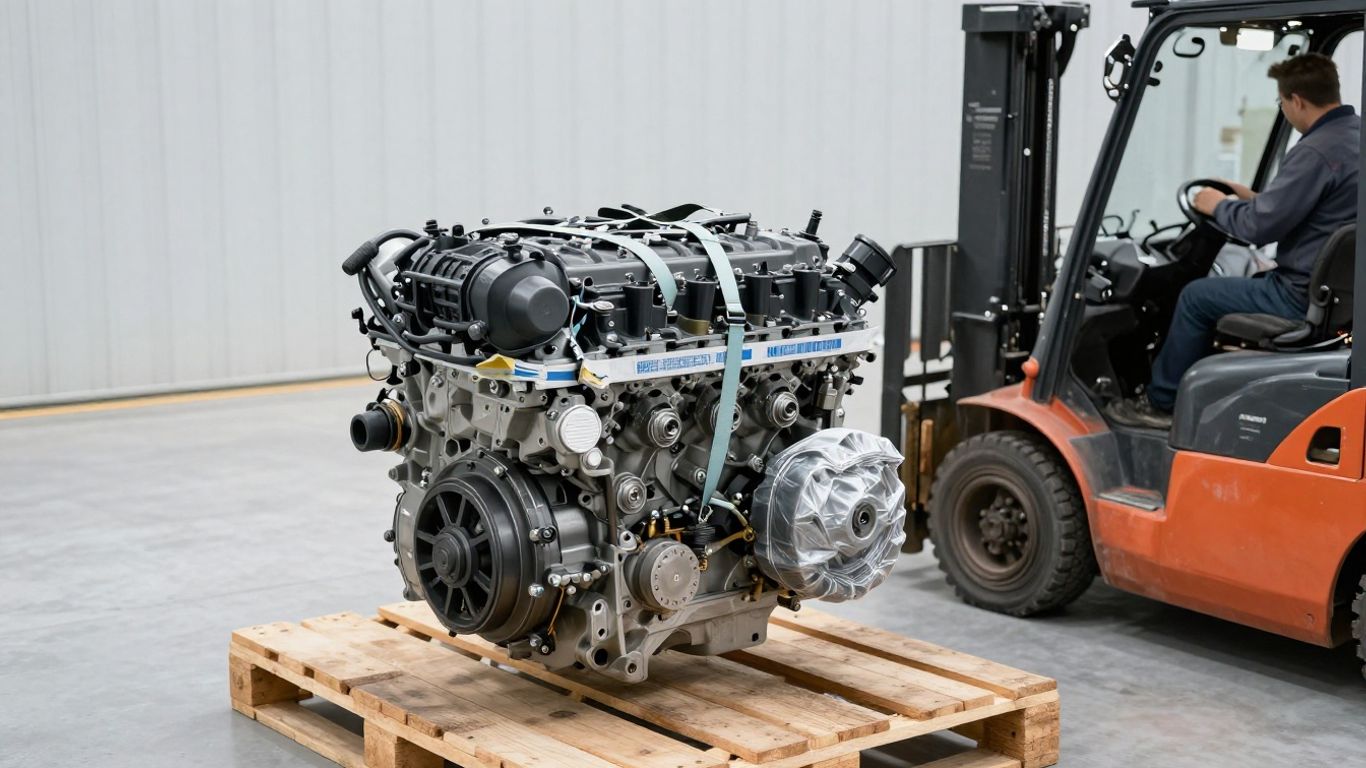
Comparing courier, freight, and specialized carriers
Courier networks can suit smaller components, but a complete engine usually needs freight handling because of its weight, dimensions, and center of gravity. Specialized providers may offer collection and packing support, while general freight carriers may expect the shipper to prepare a compliant pallet or crate. Describe the engine accurately instead of relying on a broad label such as “machine part.”
Ask how the carrier handles heavy freight, whether the engine must be palletized, and what equipment is available at both ends. If the provider cannot explain loading, restraint, and delivery procedures clearly, a low price may not be a real saving. The best choice is the service that can perform the entire movement without improvised handling.
Evaluating transit times and delivery guarantees
Request a quoted transit range as well as the conditions attached to any delivery guarantee. A guaranteed date may exclude weather, inaccessible locations, incorrect dimensions, or a missed appointment. Confirm the cutoff time for pickup, whether weekends count, and when the transit clock begins.
Build a small buffer around the stated arrival date if the engine is needed for scheduled work. When comparing providers, ask for the service name, estimated time in transit, collection date, delivery window, and remedy if the commitment is missed. Written detail is more useful than a casual assurance over the phone.
Checking coverage, tracking, and customer support
Coverage should include both the origin and destination, not merely the broad region. Check whether tracking begins at booking or only after the first scan, and find out who will contact you if the shipment is held. A reachable support team matters most when an address, appointment, or handling requirement changes.
The provider’s communication process should be clear enough that the sender and receiver know what happens next. For online orders, shipping and delivery information commonly explains processing, tracking emails, regional delivery expectations, and courier questions. Use those details as a prompt to ask equivalent questions before booking an engine shipment.
Preparing an engine for fast transport
Preparation protects the carrier, the engine, and the packaging. Engines can retain oil, coolant, fuel, or other fluids, and loose accessories can become impact points during handling. Photograph the engine before packing, note visible damage, and keep a record of removed parts. Fast transport is only useful if the shipment reaches the destination ready for inspection.
Draining fluids and securing loose components
Drain fluids according to the engine’s condition and the carrier’s requirements, then cap or seal openings to prevent leakage. Remove or firmly secure components that could break away, including brackets, hoses, sensors, covers, and protruding accessories. Put small parts in a sealed, labeled container rather than leaving them loose in the crate.
Tell the carrier if the engine is non-running, partially disassembled, or unable to roll or be lifted normally. Those details affect collection equipment and handling time. Keep copies of any required fluid or hazardous-material declarations, and never assume that a drained engine needs no disclosure.
Protecting the engine from impact and moisture
Wrap vulnerable surfaces and cover openings against dust and rain, while avoiding materials that trap residual fluid against metal for a long period. Use cushioning around delicate projections, not as a substitute for structural restraint. A simple condition report with dated photographs gives the receiver a useful baseline.
Dry preparation reduces risk during loading, storage, and transfer. It also makes any new leak easier to identify. If the engine is exposed to changing temperatures, add moisture protection appropriate to the packaging without allowing the unit to sit in pooled condensation.
Measuring and weighing the shipment accurately
Measure the completed shipment, not just the bare engine. Record length, width, height, total weight, and the location of the heaviest mass after the crate or pallet is installed. Carriers use those details to assign equipment, calculate rates, and decide whether special handling is required.
A practical preparation record should include:
- Bare engine weight and packaged shipment weight.
- Final outside dimensions, including pallet or crate.
- Pickup address, access restrictions, and loading method.
- Delivery address, contact person, and receiving hours.
After recording these details, send them with clear photographs when requesting quotes. Accurate information reduces reclassification, remeasurement, and pickup failures later in the journey.
Packaging an engine for safe delivery
Packaging must control both weight and movement. An engine can damage itself or the crate if it shifts, and a weak base can fail when lifted by equipment. Choose materials for the actual mass, route, and handling environment rather than copying a package designed for a smaller component. Leave enough access for safe forklift or pallet-jack handling.
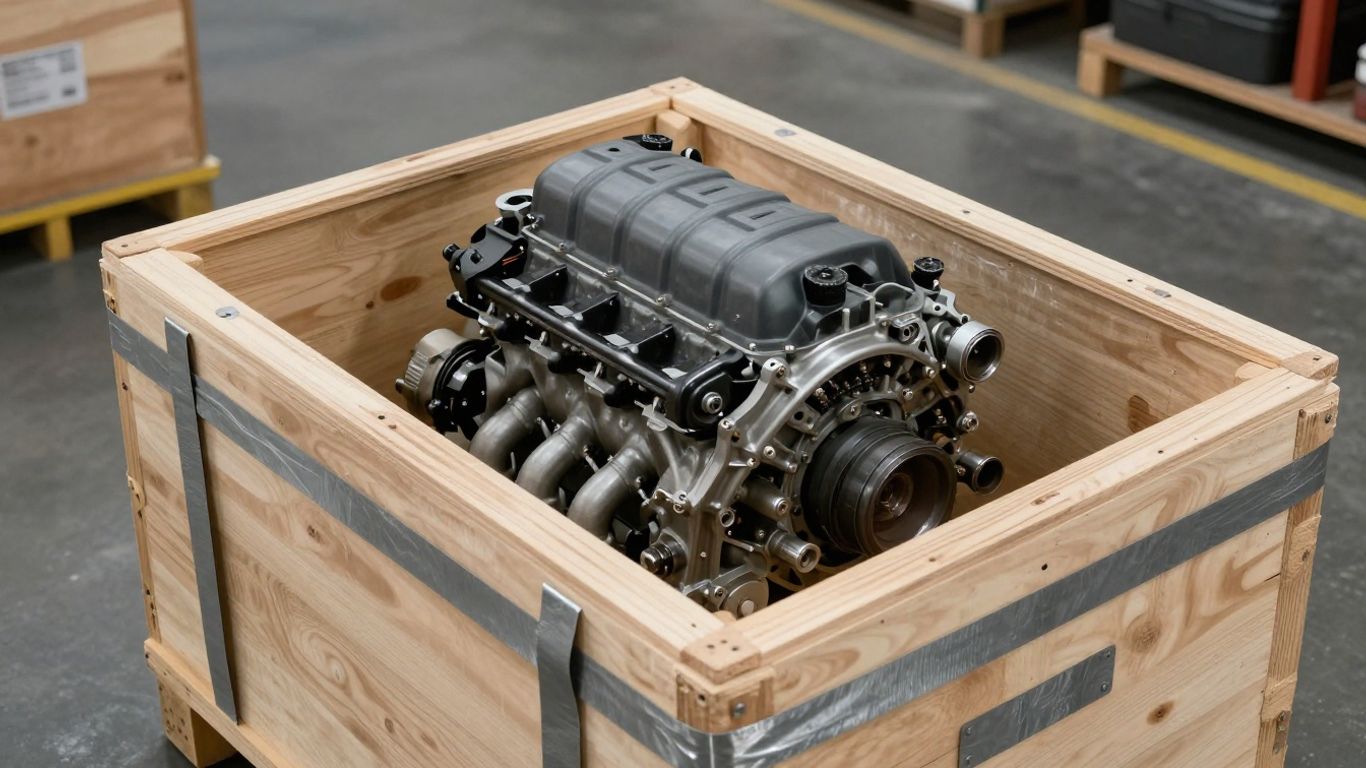
Selecting crates, pallets, and protective materials
A sound pallet may be adequate for a properly restrained engine, while a fully enclosed crate offers more protection from contact and weather. The base should distribute weight across its structure, and the walls should tolerate strapping and normal freight handling. Use blocking, edge protection, cushioning, and a moisture barrier where each serves a clear purpose.
If the packaging is being supplied by a service provider, ask what is included in the quote and whether the crate is built for the engine’s recorded weight. Professional engine packing may be useful when the sender lacks lifting equipment or suitable carpentry space. Do not seal the package until the carrier’s requirements have been checked.
Preventing shifting during transit
Restraint should hold the engine at its strongest structural points without crushing housings, covers, or fittings. Use blocks and rated straps or fasteners suited to the load, and make sure the center of gravity remains stable within the base. Padding should stop contact with the crate, not allow the engine to bounce inside it.
Test the package by checking every direction for movement before collection. Look for strap slack, loose blocking, exposed sharp edges, and a base that flexes under load. A short final check often catches the problem that would otherwise become damage during the first transfer.
Labeling the package for handling and delivery
Place the destination, sender, recipient contact, shipment reference, and weight information where handlers can see them. Add orientation and handling instructions only when they accurately describe the package and will remain visible after wrapping. Include duplicate documents in a protected pouch if the carrier requires paperwork on the outside.
Labels do not replace physical protection. They help the shipment move through the network with fewer questions, but the crate still needs to be stable, sealed, and compatible with lifting equipment. Photograph the final labeled package before it leaves.
Calculating express engine shipping costs
The price of express engine shipping reflects the shipment’s physical characteristics and the work required at each end. Distance matters, but it is only one part of the calculation. Packaging, access, timing, and delivery location can change the quote substantially. Compare like with like before deciding that one provider is cheaper.
Factors that affect the final price
Carriers may price by actual weight, dimensional space, freight class, route, and service urgency. Pickup and delivery access can add work when the engine cannot be reached by a standard truck or when a liftgate is needed. Residential delivery, appointments, limited receiving hours, remote areas, and storage can also affect the final amount.
Packaging is another cost variable. A ready-to-ship pallet may require less preparation than an engine needing collection, draining, blocking, and crating. Ask whether insurance, fuel adjustments, loading, unloading, and re-delivery are included or billed separately.
Comparing quotes from shipping providers
Request written quotes using the same weight, dimensions, addresses, service level, and access details. Then compare the practical offer, not just the headline number. The following format helps expose differences that are easy to miss in a phone estimate.
| Quote detail | Why it matters | Question to ask |
|---|---|---|
| Transit window | Shows the expected speed | When does transit begin? |
| Packaging scope | Defines who prepares the engine | Is crating included? |
| Delivery method | Determines receiving requirements | Is liftgate service included? |
| Coverage and claims | Clarifies financial protection | What documentation is required? |
Once the quotes are aligned, review exclusions and validity dates. A slightly higher complete quote may be preferable to a low estimate that leaves packaging or access charges open.
Avoiding surcharges and unexpected fees
Most avoidable fees begin with incomplete information. Recheck the dimensions after packaging, confirm whether the destination is residential or commercial, and disclose stairs, narrow entrances, appointment rules, and limited hours. Ask how waiting time, storage, re-delivery, and address changes are billed.
Keep the booking confirmation and all revisions together. If the engine’s condition or packaging changes before pickup, tell the provider immediately. Early notice gives the carrier a chance to revise the plan instead of charging for a failed collection.
Navigating paperwork and delivery requirements
Paperwork helps the carrier identify the shipment and the receiver accept it. It should agree with the physical package, booking details, invoice, and declared value. Requirements vary by route and engine type, so verify them with the provider before collection. A missing document can turn a fast service into a held shipment.
Preparing invoices and shipment documentation
Prepare a clear description, quantity, weight, dimensions, value, origin information where relevant, and the sender and receiver’s full details. Include the shipment reference and any declarations about drained fluids, used equipment, or restricted materials. Keep digital copies of the invoice, packing record, photographs, and booking confirmation.
For international movements, ask about customs documents, duties, taxes, and importer responsibilities before dispatch. Even a domestic shipment benefits from a consistent description: “engine” alone may be less useful than a precise, truthful description of the unit and its condition. Never guess at a required classification.
Understanding residential and commercial delivery rules
Commercial addresses often have defined receiving hours, loading areas, and staff familiar with freight, while residences may have tighter access and no unloading equipment. Confirm the address type when requesting the quote. Make sure the recipient knows the approximate delivery window and can answer the driver’s call.
A business address is not automatically suitable if it cannot accept a heavy crate. Conversely, a residential delivery may work if the provider confirms the equipment and appointment requirements. Shipping policy details illustrate why address type, carrier arrangements, and signature procedures should be checked in advance.
Planning for liftgate service and delivery appointments
A liftgate can lower freight from a truck when a loading dock or forklift is unavailable, but it must be requested and may have restrictions. Confirm the truck can reach the delivery point and that there is a firm, level area for receiving the crate. If an appointment is required, provide accurate contact details and receiving hours.
The receiver should have suitable help and equipment ready before the driver arrives. If that is not possible, arrange delivery to a facility that can safely unload the engine. Planning this step early is often cheaper and safer than improvising at the curb.
Tracking and receiving an express engine shipment
Tracking is most useful when it supports action, not when it is checked without context. Save the reference number, watch for pickup and transfer scans, and remain available around the stated delivery window. The receiver should know who is authorized to sign and where the shipment can be inspected. A calm receiving process protects both the engine and the claim record.
Monitoring the shipment from pickup to arrival
Check that the first scan appears after collection and compare the status with the promised route and service level. If the shipment stops moving, contact support with the reference number, pickup date, and destination rather than waiting until the delivery window has passed. Keep the sender and receiver aligned on any revised timing.
Some order systems send confirmation and tracking emails, as described in delivery tracking information. For an engine shipment, also keep the carrier’s phone contact and the delivery appointment details in one place. Tracking cannot correct a bad address, so verify that information before dispatch.
Inspecting the engine for damage
Inspect the crate, pallet, straps, corners, wrapping, and any signs of fluid leakage before signing. Photograph the package from several angles, then compare the engine with the condition report and pre-shipment images. If damage is visible, record it on the delivery receipt and notify the carrier promptly.
Do not discard damaged packaging until the provider or insurer confirms that it is no longer needed. If the outer package looks sound but the engine has an issue, document that too and avoid disassembling or repairing the unit before receiving instructions. Clear evidence makes the next step easier.
Handling delays, claims, and delivery problems
For a delay, ask for the specific cause, current location, revised estimate, and available remedy. For damage or loss, preserve documents, photographs, packaging, receipts, and communication records. Follow the carrier’s claim deadline and provide only accurate, consistent information.
A delivery problem is easier to resolve when the booking reflects the actual shipment. If an address, weight, condition, or access detail was incorrect, acknowledge it while asking what corrective option is available. Prompt, factual communication usually achieves more than an angry exchange.
Conclusion
A successful express engine shipping plan starts before the carrier arrives: prepare the engine, measure the finished package, compare complete quotes, and confirm how the destination will receive it. Those steps make urgent transport more predictable while giving the shipment its best chance of arriving safely and on schedule.
Frequently Asked Questions
How quickly can an engine be shipped?
Timing depends on distance, service level, route, packaging readiness, pickup access, weather, and delivery conditions. Ask for a written transit window rather than relying on a general estimate.
Can an engine be shipped without a crate?
Some carriers accept a properly secured pallet, while others require a crate. Confirm the carrier’s packaging standard before booking and ensure the engine cannot shift during handling.
Should all fluids be removed before shipping?
Drain and seal fluids according to the carrier’s rules and the engine’s condition. Disclose any remaining fluid or restricted material before collection.
Is expedited shipping always direct?
No. Express service prioritizes a shipment but may still involve terminals, transfers, or scheduled linehaul movement. Ask whether the quoted service includes direct transport.
What information is needed for a shipping quote?
Provide the origin and destination, packaged dimensions, total weight, engine condition, packaging type, address type, access details, and desired delivery timing.
What should the receiver do if the crate is damaged?
Photograph the damage before opening, note it on the delivery receipt, and contact the carrier promptly. Keep the packaging and related documents for inspection or a claim.
Are residential engine deliveries possible?
They may be possible if the carrier confirms access, unloading equipment, and appointment requirements. A commercial location with suitable receiving facilities can sometimes simplify delivery.