

Key Takeaways
A used engine can be part of an insurance repair, but approval usually depends on why the original engine failed, what the policy covers, and whether the replacement is suitable for the vehicle.
- Collision and comprehensive coverage generally address sudden, covered events rather than ordinary mechanical failure.
- An insurer may approve a used engine when it is a reasonable, compatible repair for the damaged vehicle.
- Diagnosis, photographs, maintenance records, and a detailed estimate can make the claim easier to assess.
- Mileage, testing, warranty terms, and included components matter when evaluating a replacement engine.
- A denial can often be clarified or challenged through policy review, supplemental evidence, and formal escalation.
How insurance coverage applies to engine damage
An engine problem does not automatically become an insurance claim. The central question is usually whether a covered event caused the damage, rather than whether the engine simply stopped working. Before arranging a replacement, identify the cause of failure, read the relevant policy language, and ask the insurer what evidence it needs. That early distinction can prevent a costly repair from being treated as an uncovered breakdown.
Mechanical breakdown versus covered accident damage
Mechanical breakdown commonly develops through wear, overheating, poor maintenance, corrosion, or an internal component failure. Standard car insurance often does not cover those causes because they are maintenance or reliability issues rather than sudden insured events. By contrast, a collision that damages the engine, floodwater entering the vehicle, fire, vandalism, or another covered peril may create a valid claim, depending on the policy.
A repair shop should describe what it can actually observe and diagnose. If the engine had a pre-existing problem before an accident, claiming that the accident caused the entire failure can create serious complications. A clear timeline, including warning lights, noises, loss of power, the accident itself, and the vehicle’s condition afterward, helps separate prior mechanical trouble from accident damage.
A useful overview of when car insurance covers engine failure can help frame the initial question, but the policy controlling the claim is the one issued to you. General explanations cannot replace its exclusions, endorsements, definitions, or claim conditions.
Comprehensive and collision coverage limitations
Collision coverage is generally associated with damage caused by hitting another vehicle or object, while comprehensive coverage may respond to certain non-collision events such as flooding, fire, theft, vandalism, falling objects, or animal damage. The precise list varies by policy and jurisdiction. Liability coverage ordinarily protects other people from damage you cause; it does not usually pay to repair your own engine after a routine failure.
The phrase “full coverage” can be misleading. It is often used casually for a policy that includes collision and comprehensive coverage, but it does not mean every engine problem is insured. Even when one of those coverages applies, exclusions, deductibles, policy limits, and questions about the vehicle’s pre-loss condition still matter.
When a policy may cover a defective replacement engine
A replacement engine may be relevant to a covered claim when the original engine was damaged by an insured event and replacement is the reasonable method of restoring the vehicle. That is different from an engine that fails because of a manufacturing defect, an old unresolved problem, or ordinary wear. A warranty, service contract, or mechanical breakdown policy may be the more appropriate source of protection for those situations.
If a newly installed replacement engine fails, start by checking the repair invoice and the supplier’s warranty before assuming the original insurance claim reopens. Insurance generally addresses the covered loss described in the claim; it may not become a general guarantee of every subsequent repair. Keep the insurer informed if the replacement reveals additional damage related to the original event.
How deductibles and policy limits affect the claim
Even an approved claim may not cover the full invoice. The deductible is usually the portion you pay before the insurer contributes, while policy limits and the vehicle’s value can constrain the total payment. If the repair cost approaches the vehicle’s actual cash value, the insurer may examine whether repairing the car remains economically reasonable under the policy and applicable rules.
Ask for the estimate in writing and check whether it includes teardown, diagnostic time, taxes, towing, fluids, seals, programming, and related parts. The approved amount matters as much as the headline engine price. Differences between the insurer’s estimate and the repairer’s invoice should be identified before work is authorized, not after the vehicle is apart.
When an insurance company may approve a used engine
Insurers often consider the least costly repair that returns a vehicle to its pre-loss condition, subject to the policy and local requirements. A used engine can therefore be considered when it is available, compatible, and reasonably comparable to the damaged unit. Approval is not automatic, and “used” does not by itself mean unsafe or unacceptable. The supporting evidence should show what the engine is, where it came from, how it was tested, and what protection comes with it.
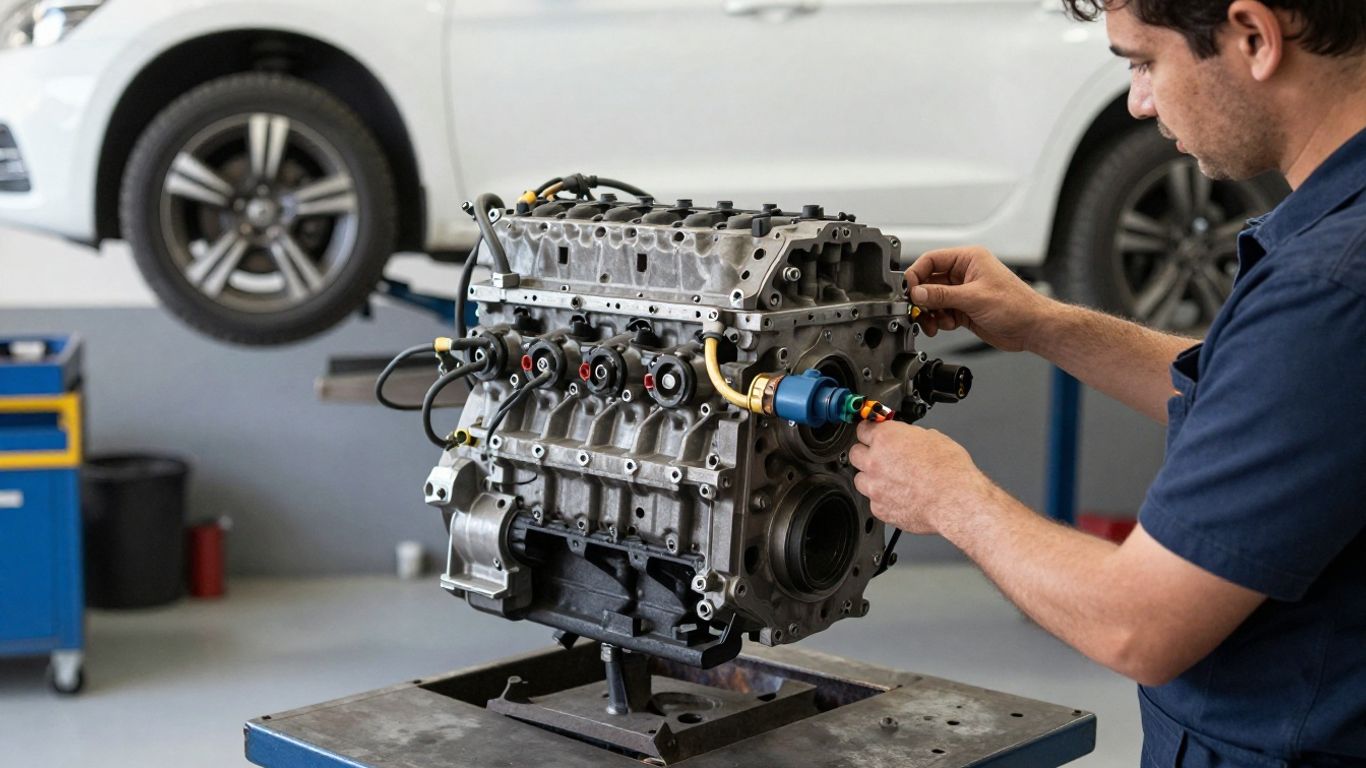
Why insurers consider used engines for repairs
A used engine may cost less than a new or remanufactured unit, which can help keep a repair within the vehicle’s value and the insurer’s reasonable-cost analysis. It may also be a practical way to source an engine for an older vehicle whose original equipment is no longer readily available. The goal is generally restoration, not an upgrade beyond the vehicle’s condition before the loss.
The insurer may compare several repair paths, including repairing the original engine, installing a used assembly, or using a remanufactured unit. A repair shop can make that conversation clearer by listing the estimated part cost, labor, expected delivery time, warranty, and any additional work required for each option. A lower price is useful only if the replacement is suitable and the warranty is meaningful.
OEM, remanufactured, and salvage engine differences
An OEM engine or assembly is associated with the vehicle manufacturer’s original specification, although the exact source and condition still need to be confirmed. A remanufactured engine has generally been disassembled, inspected, and rebuilt according to the supplier’s process. A salvage or used engine is removed from another vehicle and may retain its original internal components, with condition and testing varying by supplier.
These labels should not be treated as interchangeable. Ask what “tested” means, whether the unit was compression-tested or run before removal, what mileage is documented, and which parts are included. The appropriate choice depends on the vehicle, policy, availability, estimate, and the repairer’s assessment rather than on the label alone.
Age, mileage, and compatibility requirements
The replacement should match the vehicle’s year, make, model, engine family, drivetrain, emissions configuration, and transmission requirements. The engine code or identification number is often more useful than a broad model description. Differences in sensors, wiring, intake and exhaust fittings, computers, mounts, or accessory brackets can turn an apparently inexpensive engine into an expensive adaptation.
Mileage and age may influence whether an insurer considers the engine reasonably comparable. They can also affect the supplier’s warranty and the repair shop’s willingness to install it. Before approval, request documentation for the donor vehicle, mileage, testing, storage conditions, and any known damage. If exact mileage is unavailable, that uncertainty should be recorded rather than glossed over.
How state rules and policy language influence approval
Insurance rules differ by state, and policy language may set standards for parts, disclosure, repair procedures, inspections, or dispute handling. Some policies allow non-original parts under stated conditions; others may require particular notices or give the vehicle owner options. A repairer or claims representative can explain process, but the written policy and applicable law remain the stronger references.
Ask whether prior authorization is required before ordering or installing the engine. Also ask who selects the supplier, who pays a price difference if you choose a more expensive unit, and how a disagreement about quality will be handled. Written answers are more useful than an informal assurance made during a phone call.
How to file an insurance claim for a used engine
A claim becomes easier to evaluate when the story is chronological and supported by records. Report the event promptly, protect the vehicle from further damage, and avoid authorizing major teardown before the insurer has had a fair opportunity to inspect it, unless immediate action is necessary. The objective is not to demand a particular part at the outset; it is to establish the loss and then support a reasonable repair method.
Documenting the damage and vehicle condition
Take photographs of the vehicle from several angles, the accident scene when safe, fluid leaks, warning lights, visible impact points, and any damaged components. Save towing receipts, storage invoices, police or incident reports, and the names of people who witnessed what happened. If the engine failed after water exposure or fire, photographs of the surrounding damage may help establish the event’s scope.
Write down what happened while the details are fresh. Include the vehicle’s mileage, recent symptoms, whether it was driveable, and what occurred immediately before the failure. Do not remove or discard damaged parts unless the insurer or repairer confirms that preservation is unnecessary.
Getting a diagnosis from a qualified repair shop
Choose a repair shop that can explain the diagnosis in plain language and identify the evidence supporting it. The written report should distinguish confirmed damage from suspected damage, identify the likely cause, and state whether repair or replacement is recommended. If teardown is needed to determine the cause, ask who will authorize and pay for that diagnostic work.
A second opinion can be useful when the first diagnosis is uncertain or when the proposed replacement seems disproportionate to the vehicle’s condition. It should address the same facts rather than simply produce a different total. Good documentation gives the adjuster something concrete to review and gives you a basis for questioning an incomplete estimate.
Submitting estimates, photographs, and maintenance records
Send a coherent package rather than a collection of unrelated attachments. Include the repair estimate, diagnosis, photographs, invoices, maintenance records, towing documents, and any information about the proposed used engine. Maintenance records do not guarantee coverage, but they can help show the vehicle’s condition before the event and answer questions about neglect or pre-existing damage.
The following checklist covers the material most often worth gathering before the adjuster reviews the repair:
- A dated description of the event and the engine symptoms that followed.
- Photographs of the vehicle, impact area, engine bay, and visible fluid or fire damage.
- A written diagnosis explaining causation and the proposed repair.
- A detailed estimate separating parts, labor, fluids, taxes, and related work.
- Vehicle records showing mileage, servicing, ownership, and prior repairs.
After sending the package, keep copies and note the date, recipient, and claim number. A complete submission reduces repeated requests and makes it easier to identify what remains unresolved.
Working with the adjuster and responding to delays
The adjuster may arrange an inspection, request additional records, or ask the repair shop to explain its estimate. Respond within the requested time, but do not guess when you do not know an answer. Ask for the reason for each delay, the next expected step, and whether the vehicle should remain at the repair facility or be moved to a less costly location.
You can also ask whether the proposed used engine has been approved before it is ordered. If the adjuster and repairer disagree about labor hours, parts, or warranty terms, request that the differences be listed in writing. The auto insurance claim filing process offers a useful general framework for organizing communications, even though your own policy determines the specific requirements.
How to evaluate a used engine before installation
Approval of a used engine is only one stage of the process. Before installation, confirm that the unit ordered is the unit described in the estimate and that the shop has checked its compatibility. A replacement that arrives with missing accessories, an uncertain identity, or a vague warranty can create delays and disputes. Whenever possible, resolve those questions while the engine can still be returned.
Checking the engine identification and compatibility
Compare the engine code, casting or identification information, donor vehicle details, and supplier invoice with the vehicle identification number and repair estimate. Confirm whether the replacement is a complete assembly or a long block, and identify which original components will be transferred. The shop should verify mounts, sensors, wiring, computer compatibility, emissions equipment, transmission connections, and accessory fitment.
Do not rely on a listing that says only “fits” a broad range of vehicles. A vehicle may have several engine options in one model year, and regional emissions or drivetrain differences can matter. Written confirmation from the supplier and the installing shop is preferable to an assumption based on appearance.
Reviewing mileage, testing, and vehicle history
Ask for the donor vehicle’s mileage and history, along with the tests performed before sale. Useful information may include whether the engine was started, compression-tested, inspected for leaks, or checked for abnormal noise. Testing terminology varies, so ask the supplier to define it rather than treating a single word as a guarantee.
The donor vehicle’s history can reveal flood, fire, severe collision, or long-term storage concerns. A clean-looking exterior does not prove that the engine is sound. If the supplier cannot provide basic identification, mileage, testing information, or return terms, pause and ask the repairer whether another source is more appropriate.
Confirming included parts and required accessories
An engine listing may include only the core assembly. Intake and exhaust components, injectors, sensors, starter, alternator, air-conditioning compressor, brackets, wiring, oil pan, flywheel, fluids, and seals may be excluded or transferred from the damaged vehicle. Those details affect both the final price and the installation time.
Have the repair shop mark the estimate to show what is included, what will be reused, and what must be replaced. New gaskets, seals, filters, fluids, belts, or hoses may be sensible installation items even when they are not part of the used engine itself. Clarifying this before delivery helps avoid a second approval request after labor has begun.
Recognizing warning signs of poor-quality inventory
Be cautious when the seller cannot identify the donor vehicle, offers no meaningful test information, or uses a warranty that excludes nearly every likely failure. An unusually low price can also reflect missing components, uncertain mileage, damage from storage, or a short return window. None of these signs proves that an engine is defective, but each deserves a direct question.
Inspect the unit for obvious cracks, broken connectors, heavy corrosion, contamination, impact damage, and signs of improper storage. Photograph the engine when it arrives and before installation. If the condition differs materially from the agreed description, notify the supplier and insurer promptly rather than allowing the discrepancy to disappear into the installation process.
Costs, warranties, and out-of-pocket expenses
The engine itself is only one line in a replacement estimate. Labor, diagnosis, transportation, fluids, seals, programming, taxes, disposal, and related repairs can materially change the total. An insurance payment may also be reduced by the deductible or limited by the insurer’s approved estimate. A careful comparison should therefore use complete installed costs, not just advertised part prices.
Comparing used-engine prices with remanufactured options
A used engine usually has a lower purchase price, while a remanufactured option may include more inspection or rebuilding work. That does not make one universally better. Compare the total installed price, expected availability, warranty length, exclusions, shipping, return conditions, and the vehicle’s remaining value.
Ask the repairer to explain whether a more expensive option offers a practical benefit for this particular vehicle. If the insurer approves a used engine and you prefer a remanufactured one, determine in advance whether you must pay the difference. Do not assume the insurer will reimburse an upgrade simply because it is technically available.
Understanding labor, fluids, seals, and related repairs
Engine replacement may require removal and transfer of accessories, replacement of damaged mounts, fresh fluids and filters, computer programming, cooling-system work, or diagnostic testing after installation. Some related items may have been damaged in the same covered event; others may simply be due for service. The estimate should separate those categories so the claim does not become difficult to follow.
Ask whether the shop’s labor warranty covers installation-related problems and whether the insurer has approved supplemental work. Keep invoices for all payments and record who authorized each additional item. These habits are particularly valuable when the final invoice is higher than the initial estimate.
Reviewing salvage-yard and supplier warranties
A salvage-yard warranty may cover replacement of the engine for a defined period or mileage, but its terms can be narrower than many drivers expect. It may require professional installation, retention of failed parts, proof of maintenance, or prompt notification of a problem. Some warranties cover parts only and exclude labor, fluids, towing, diagnostics, or consequential damage.
Read the warranty before installation and ask how a claim is opened. Confirm who pays shipping for a replacement engine and whether the supplier offers a refund, exchange, or repair. A written warranty is only useful if its obligations and exclusions are understandable.
Handling warranty exclusions and limited coverage periods
Limited coverage periods can expire quickly if the vehicle is driven very little or if a defect is not immediately obvious. Follow the recommended break-in, inspection, and maintenance procedures, and keep receipts. If a warning light, leak, unusual noise, or loss of power appears, stop driving when safe and notify the repairer and supplier promptly.
The table below illustrates the questions to compare; it is not a substitute for the actual warranty or policy.
| Cost or protection item | Question to ask | Why it matters |
|---|---|---|
| Engine assembly | What exactly is included? | Missing accessories can increase the installed cost. |
| Labor | Is installation covered by the estimate or warranty? | A replacement part warranty may exclude labor. |
| Testing | What tests were completed before sale? | Testing information helps assess condition and risk. |
| Return terms | How long is the return window and who pays shipping? | A defective unit may need prompt removal or exchange. |
| Maintenance | What service is required to preserve coverage? | Missed requirements can limit a later warranty claim. |
Reading each row against the supplier’s written terms makes the comparison more useful than relying on a broad phrase such as “parts and labor covered.” Keep the policy, estimate, invoice, and warranty together in one file.
What to do if the insurer denies the claim
A denial is a decision to examine, not necessarily the end of the matter. The letter should identify the policy provision, exclusion, factual finding, or estimate issue behind the decision. Read it alongside the diagnosis and your timeline, then decide whether the disagreement concerns coverage, causation, repair method, valuation, or missing information.
Reviewing the denial reason and policy wording
Start with the exact wording cited by the insurer and compare it with the facts of the loss. A denial based on mechanical breakdown may be appropriate if the engine failed independently of an accident, but the analysis may differ if the evidence shows impact, flood, fire, or another covered event caused the damage. Definitions and exclusions can change the meaning of familiar terms.
Mark the sections of the policy that appear relevant and ask the insurer to explain any unclear language. Keep the conversation focused on the stated reason for denial rather than arguing generally that the repair is expensive or that the vehicle is unusable.
Requesting a written explanation or supplemental inspection
If the denial was given by phone, request a written decision. Ask for the inspection photographs, adjuster notes, estimate, and any technical basis the insurer relied on, subject to applicable privacy and claims procedures. A supplemental inspection may be appropriate when the first inspection missed hidden damage or occurred before the engine was properly examined.
Give the repair shop the denial reason and ask for a focused response. A useful supplement should address the insurer’s actual concern, such as causation, pre-existing damage, compatibility, or the price of the replacement. Repeating the original estimate without new evidence is less likely to change the outcome.
Challenging an estimate with independent documentation
You can obtain an independent diagnosis or estimate from another qualified repairer, but it should explain the differences in method and scope. Compare part numbers, engine condition, labor operations, taxes, warranty terms, and related repairs line by line. If the insurer’s estimate omits necessary work, ask the shop to identify why that work is required and provide supporting photographs or technical findings.
Keep communication factual and dated. Submit the new material with a short cover note stating what changed and what decision you are asking the insurer to reconsider. If the vehicle may be treated as a total loss, review the separate rules and valuation process rather than assuming a replacement-engine dispute will be handled only as a repair disagreement.
Escalating through the insurer, regulator, or legal counsel
Use the insurer’s internal complaint or review process before escalating externally when the policy requires it or when it is likely to resolve a documentation issue. If the response remains unsatisfactory, your state insurance regulator may explain complaint procedures and applicable consumer protections. The regulator may not decide every private coverage dispute, but its process can identify whether the insurer followed required standards.
Legal advice may be sensible when the amount is substantial, the policy wording is disputed, or the denial could affect a total-loss decision. Bring the policy, denial letter, estimates, photographs, correspondence, and repair records to any consultation. Avoid authorizing irreversible work while a material coverage dispute remains unresolved unless you understand the financial risk.
Conclusion
A successful insurance claim used engines process rests on three connected questions: what caused the engine damage, what repair does the policy support, and whether the proposed used engine is properly identified, compatible, and warranted. Careful records and written communication cannot guarantee approval, but they give the insurer, repairer, and vehicle owner a clearer basis for reaching a fair decision.
Frequently Asked Questions
Does car insurance usually cover a blown engine?
Usually not when the failure results from wear, poor maintenance, overheating, or an internal mechanical defect. Coverage may apply when a collision, flood, fire, vandalism, theft, or another covered event caused the damage.
Can an insurer require a used engine?
An insurer may propose a used engine as a reasonable repair option when it is compatible and comparable to the vehicle’s pre-loss condition. The policy, applicable rules, estimate, and documented condition determine whether that proposal is acceptable.
Should I order a used engine before the claim is approved?
It is generally safer to obtain written authorization before ordering or installing a replacement. Otherwise, you may be responsible for the cost if the claim is denied or the insurer approves a different repair method.
What records help support an engine claim?
Useful records include the incident report, photographs, diagnosis, repair estimate, maintenance history, towing invoices, mileage, and documentation for the proposed replacement engine. Keep copies of all communications with the insurer and repairer.
What is the difference between a used and remanufactured engine?
A used engine is generally removed from another vehicle and sold in its existing condition, subject to the supplier’s testing and warranty. A remanufactured engine has typically been disassembled, inspected, and rebuilt through a defined process.
What happens if the replacement engine fails under warranty?
Notify the supplier and installing repairer promptly, follow the warranty’s required procedure, and preserve invoices and failed parts. Check whether the warranty covers labor, towing, fluids, diagnostics, and shipping, since those items are often treated separately.
Can I challenge an insurance claim denial?
You can review the cited policy language, request a written explanation, submit additional evidence or an independent inspection, and use the insurer’s complaint process. A regulator or legal adviser may be appropriate if the dispute remains unresolved or involves substantial losses.